
Badlands Brief
Arctic Escalation and Tropic Trouble for the Financial System

The Badlands Brief is your daily drop of Badlands’ takes on the narratives dominating the info war. Read on, and join the conversation in the comments section.
Trump vs the EU re: Greenland
U.S. President Donald Trump has escalated diplomatic tensions with close European allies by announcing a 10% tariff on imports from eight European countries that have opposed U.S. efforts to assert greater influence over Greenland. The tariff, set to begin February 1, targets Denmark, Norway, Sweden, France, Germany, the United Kingdom, the Netherlands and Finland, and is explicitly linked to Trump’s long-standing objective of securing American control of the Arctic island, which he described as crucial to national security.
European leaders responded with unified criticism, warning that linking trade policy to territorial ambitions undermines transatlantic relations and risks a “dangerous downward spiral.” They emphasized support for the sovereignty of Greenland and Denmark and condemned the use of tariffs as coercive leverage.
The United Kingdom’s government called its stance on Greenland’s future “non-negotiable,” with senior politicians across parties rejecting Trump’s tariffs and underscoring the importance of diplomatic engagement.
European Union officials signaled readiness to coordinate trade counter-measures and consider suspending parts of EU-U.S. trade agreements if the United States proceeds with additional tariffs, citing legal and economic concerns.
Despite the political tensions, military cooperation appears to persist. Denmark’s Joint Arctic Command stated there are no immediate Chinese or Russian naval threats near Greenland waters and reaffirmed ongoing NATO collaboration, even as broader strategic disagreements with the United States continue.
The row highlights deepening friction between Washington and its NATO allies over Arctic security, trade policy, and the future status of Greenland—a semi-autonomous territory of the Kingdom of Denmark.
Burning Bright: Greenland may be the Actual and Narrative Keystone to the codification of a new Pax Americana ... and a shining example of Bicameral Sovereign Shielding.
(Yes. That’s a lot of BB terms. I’ll make no apologies.)
Donald Trump’s message is being delivered to whichever regime would operate behind the public-facing one, warning the shadowy apparatus to get in line like we’re told Venezuela has (with the Maduro Regime still completely intact,) and as Colombia soon followed.
Iran, meanwhile watches its own streets convulse under the compounded pressures of economic collapse and popular fury.
Or so we’re told, though the difference between organic uprising and globalist-funded color revolution can be difficult to trace these days.
To wit, warmongers on all sides of the sociopolitical zeitgeist are seemingly being baited into stances Trump abandons almost immediately after issuing them.
Even our so-called allies—the architects and beneficiaries of the old order Trump is in the midst of dismantling—find themselves on the receiving end of a refrain that should be old hat to them with how long Vladimir Putin has been training them according to its tenets.
Last week, I said the following about Trump’s Greenland Gambit:
“Greenland, strategic linchpin in the Arctic coveted by Trump since his first term for its position astride Russian and Chinese ambitions is a potential flashpoint in the emergence of the new Pax Americana that is as logical as it is shocking to the calcified western psyche, long rooted in its post-war paradigm.
So, while the Danish Prime Minister issues a grave public warning that any American move to seize the island would ‘destroy NATO,’ behind closed doors, the Europeans—the UK, Germany and France—scramble to assemble a counter-proposal: a multinational NATO Arctic force ... anything to appease the American sovereign before he makes good on promises that once sounded like bluster and now look like anything but.
This is an actual cascade of rapidly shifting geopolitics and posturing all aligning around the new projected and actualizing American era, and all it took was one story whose actuals could be debated until the end of time.
The translation is universal: even the institutions built to constrain American power now react with the instinctive deference of entities that remember, deep in their foundational coding, who ultimately underwrote their existence.”
Now, it seems Regime players are rushing to help Trump cement that Narrative, and the need for a wholesale multipolar paradigm shift, whether they know it or not.
Trump’s message?
The same one as Putin and Xi Jinping.
Power is Power.
I’ve been arguing this since my foundational series, Righteous Russia.
And in this deliberate reminder, Trump does not stand alone.
He mirrors—whether by design, convergence or sovereign parallelism—the public postures long adopted by Vladimir Putin and Xi Jinping.
Russia has spent years demonstrating, through action on its engineered borderlands and restraint elsewhere that without the credible threat of American kinetic projection, the globalist machine is hollow.
Sanctions become paper. Alliances dissolve. Narratives of moral superiority ring empty when unbacked by force.
Meanwhile, China flexes in the South China Sea and along its borders, translating the same lesson: rules without enforcing power are mere suggestions, politely ignored.
And BOTH leaders (who represent two of three pillars of my long-theorized Sovereign Alliance, with Trump as the third,) are now operating in a macro narrative environment wherein Regime Change is back on the menu, and decidedly against the interests of those who wrote the book on it.
Far from hurtling the world toward open war, this shared refrain from the Sovereign Trinity—Power is Power—lays the foundation for a multipolar peace unlike any the modern era has witnessed, perhaps unlike any in recorded history.
The kicker?
It is the very rivalry (rather, the Narrative OF that rivalry) between the US, Russia and China that the Globalist machine has been stoking for a decade and more that is granting all three the respective paradigm shields they need to shatter the old one en route to the new.
Trump Suggests Cancelling the Midterm Elections
President Donald Trump has drawn national attention ahead of the 2026 midterm elections by suggesting in a January Reuters interview that the United States “shouldn’t even have an election” this year because of what he described as the success of his administration, remarks his White House press secretary later characterized as jokingly made.
In the same interview, Trump acknowledged concerns within his party about potential losses in the November midterms, noting that historically the party of an incumbent president often loses seats in Congress.
White House Press Secretary Karoline Leavitt responded to criticism of the comments by saying the president was speaking facetiously and was referring to his view that the country was “on the right track.”
Public opinion data ahead of the midterms indicate challenges for Republicans. A national poll aggregated by RealClearPolitics showed Democrats holding a narrow lead on the generic congressional ballot, with Democratic congressional candidates at about 46 percent support and Republican candidates at about 41 percent. Concurrent surveys show Trump’s job approval rating below 50 percent, with disapproval higher in several recent polls.
Trump has also emphasized policy initiatives in the run-up to the elections, including a $50 billion rural health plan aimed at addressing challenges in rural healthcare systems.
Separately, Trump told House Republicans in early January that the party must win the midterms or risk impeachment proceedings if Democrats retake control of Congress.
Control of the House and Senate after the 2026 elections will shape the final two years of Trump’s presidency, with internal Republican concerns and shifting public opinion adding to the political stakes.
Ashe in America: The same people who still support Ukraine — which cancelled elections years ago “for democracy” and never looked back — are now very concerned about President Trump canceling the midterms.
The argument being forwarded by CNN (based on the work of the Congressional Research Service) is that cancelling fake elections is worse than elections being fake.
How very silly.
Fake elections are treason. They aren’t fake by accident. They’re fake on purpose, and a lot of people are in on it. The same people that have spent the past several years obstructing and character assassinating the people pointing out the fake elections.
They all know that the will of the people is a fabrication. They’re in on it.
And they’re in on it to serve the interests of globalism.
That’s treason.
We can’t have real elections until we are honest about how fake they are. That doesn’t mean blaming some foreign nation and rewriting the role of US intelligence in the scheme of deception.
It means holding the Americans accountable.
I have no doubt that, if President Trump (and Congress) postpone the midterms, it will only be (1) due to the fact that elections are fake, and (2) in service of accountability and due process for the people involved in fake elections…
Trump will only cancel elections for democracy.
And that’s a good thing.
Give your Valentine the All Good treatment!
Make Self-Care Great Again this Valentine's Day with All Good by Jessica Storm! Get a Free Sample of Tallow Sunscreen with any bundle purchase. Offer valid thru 2/14 with promocode BADLANDS

Venezuelan Devo Proofs; Trump vs the Bankers
U.S. officials engaged in months of covert discussions with Venezuelan Interior Minister Diosdado Cabello before and after a January 3 U.S. military operation that resulted in the capture of Venezuelan President Nicolás Maduro, sources familiar with the matter told Reuters. In those talks, U.S. personnel warned Cabello—who remains under U.S. sanctions and indictment—to refrain from using security forces or militias against political opposition.
On January 9, President Donald Trump signed an executive order titled “Safeguarding Venezuelan Oil Revenue for the Good of the American and Venezuelan People,” aimed at shielding Venezuelan oil revenues held in U.S. Treasury accounts from seizure or judicial attachment. The White House said the action is meant to protect funds so they can support U.S. foreign policy goals and help stabilize Venezuela’s economy.
In a significant diplomatic development, CIA Director John Ratcliffe traveled to Caracas to meet with acting Venezuelan President Delcy Rodríguez, the highest-ranking U.S. official visit since Maduro’s ouster. The two-hour meeting focused on strengthening bilateral cooperation, including security and efforts to curb Venezuela’s role as a haven for criminal networks.
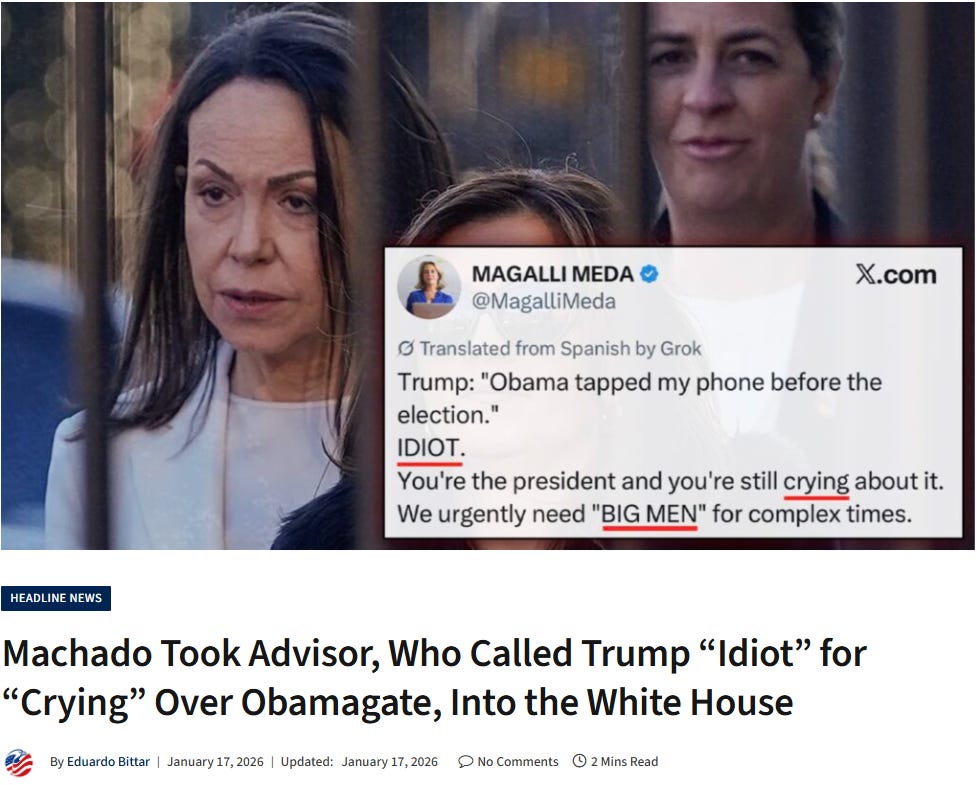
Meanwhile, an unverified political commentary claimed that opposition leader María Corina Machado brought an advisor into the White House who had previously insulted President Trump.
GhostofBasedPatrickHenry: There is a clear continuity of the Maduro plotline between the first and second Trump administrations, with Ric Grennel meeting Jorge Rodriguez— the brother to now acting Venezuelan President Delcy Rodriguez— in Mexico City in late 2020. That story was even reported at the time as Grennel trying to secretly negotiate an exit for Maduro, though I am unconvinced that was the real intent.
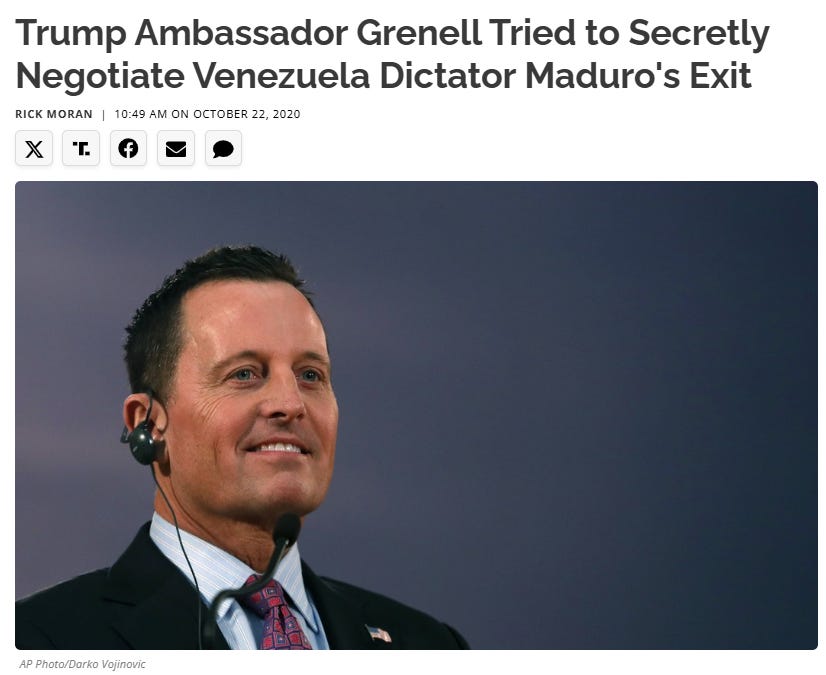
Ric Grennel then reunited with Jorge Rodriguez in January of last year, after President Trump was sworn in, when Grennel went to Caracas to meet Maduro and bring home six Americans who had been imprisoned.
With the benefit of hindsight, it seems to me that Maduro’s exit has been perfectly timed to coincide with a move against the global banking system, as the lifting of sanctions by Treasury Secretary Scott Bessent and the signing of an Executive Order that protects the Venezuelan oil revenue from bankers and creditors by placing it in a Qatari bank account and prohibiting any liens or sanctions to be placed on it. (More on that in the next take, but you can also catch my breakdown from last night’s The Narrative with Burning Bright.)
We now have this story about Venezuelan Interior Minister Diosdado Cabello being warned about using private security forces against political opposition. What’s interesting is that Erik Prince appeared on Steve Bannon’s show last week to explain why it was important that the US not repeat the same mistakes we made in Iraq, and allow Delcy Rodriguez to contract directly with any private military contractor that may be needed to shore up security.
What’s interesting is that Erik Prince secretly traveled to Caracas in November 2019 to meet with Delcy Rodriguez, and it was even speculated at the time by the MSM that this was President Trump’s attempt to establish a backchannel with the Maduro regime, despite the fact that the Trump administration officially supported the opposition leader, Juan Guiado, in their public rhetoric.
About an hour or two after Prince appeared on Bannon’s show, President Trump took a few questions from the media while leaving the White House. When asked why he was supporting Delcy Rodriguez over Maria Corina Machado, he responded, “‘If you ever remember a place called Iraq where every single person was fired—the police, the generals, everybody was fired and they ended up being ISIS… I remember that.”
So Trump is simultaneously disclosing that the US State Department created ISIS when it hired all those private military contractors to run Iraq, while asserting that installing Maria Corina Machado as Venezuelan President would effectively yield the same result?
Based.
We are also learning that Machado brought with her to the White House an advisor who once publicly called President Trump, “an idiot,” for accusing former US President Barack Obama of spying on him.
Brilliant.
Now Dan Ratcliffe has met with Delcy Rodriguez, signaling that several of the important players from Jon Herold’s Devolution Theory seem to be involved in the diplomacy with the Maduro/Rodriguez government— which is clearly under a Continuity of Government (COG) protocol.
The Central Banker King Takes the Field; Panic in London
Canadian Prime Minister Mark Carney has initiated a significant shift in Canada’s foreign and trade policy by forging a new strategic partnership with China during a state visit in mid-January 2026, marking the first Canadian prime ministerial trip to Beijing in nearly a decade. The agreements signed with Chinese counterparts encompass a broad range of cooperation areas, including trade, energy, agriculture, finance, and tourism, and are intended to revitalize bilateral ties strained by diplomatic disputes dating back to 2018.
A central feature of the visit was a tariff reduction deal that will allow up to 49,000 Chinese electric vehicles to enter Canada under a reduced tariff rate of 6.1%, reversing a previous 100% duty. In exchange, China agreed to significantly lower tariffs on key Canadian agricultural exports such as canola seed, a move expected to unlock nearly $3 billion in trade.
Carney has signaled that these agreements form part of a broader effort to diversify Canada’s export markets and reduce economic reliance on the United States, with which relations have been tested by high tariffs and political rhetoric under U.S. President Donald Trump.
The partnership also includes preliminary cooperation pacts reopening ministerial-level talks in sectors such as clean energy, forestry, culture, and tourism. These initiatives are seen as laying the groundwork for more sustained economic engagement between the two countries.
Despite the reset in relations, China remains a much smaller export destination for Canadian goods compared to the U.S., underscoring the scale of the challenge ahead for Ottawa’s diversification strategy.
GhostofBasedPatrickHenry: As President Trump makes moves against the global banking system by lifting sanctions against Venezuela, the central banker king, Canadian Prime Minister Mark Carney, has taken the field to counteract Trump.
When asked to clarify on a comment he made about setting up a “new world order,” Carney talked about the need to restore “plural-lateralism,” citing deals such as the disastrous Trans-Pacific Partnership as an example. He also cited the need to expand the global banking system in order to expand the security architecture of the financial world, in order to prevent criminal organizations from engaging in money-laundering.
That is interesting, being that it appears that the Trump-Maduro operation is actually about exposing the widespread money-laundering occurring at the highest levels by the biggest banks, made possible by the 2018 arrest of Mathias Krull by Trump’s DOJ— who was laundering billions of dollars of money that was embezzled from Venezuela’s state oil company, PDVSA. Krull was also laundering money for the drug cartels, pled guilty to all charges, and agreed to cooperate fully in exchange for clemency on his 10-year prison sentence. (He got 65% of it knocked off.)
Krull’s testimony led to massive asset forfeitures of a number of banks and financial institutions, namely Credit Suisse, which faced insolvency in 2023 and had to purchased in an acquisition by fellow Swiss bank UBS that was ostensibly forced by the Swiss government. (All money owed to the government of Venezuela.)
With the sanctions now being lifted, the flood gates will likely open, as a civil action law suit brought by Maduro against the executives of banks, commodity trading houses, and oil companies, can now be resumed after being dismissed (without prejudice) in 2019 due to national security issues related to Trump’s sanctions.
Will the discovery reveal— along with other parallel-running narratives— that the entire global banking system is the same cartel that traffics drugs, weapons, and children (among other things) around the world?
Could this be why the Bank of England suddenly announced a warning that financial markets could collapse if the US government decides to announce the existence of aliens.
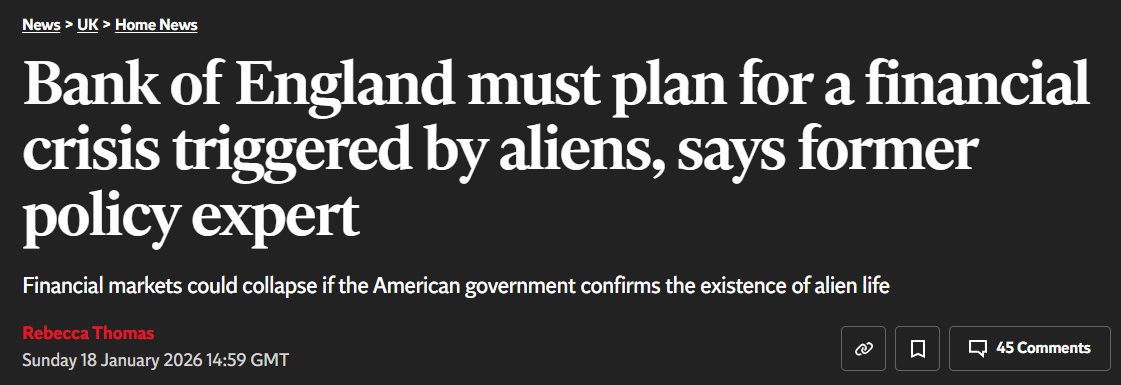
This seems so random, considering that the article acknowledges that the disclosure trend has been years in the making. Why does it seem prudent for senior analyst Helen McCaw to decide to panic over this development at this exact moment in time?
It can’t be a coincidence.
Now On Sale! Tickets to the Great American Restoration Tour in Nashville
Badlands Media hits the road four times a year for a three-day patriot-packed event with our hosts and the Badlands community. Meet like-minded Americans, hear powerful content, and be part of something real on April 9-12 in Nashville, TN.

AI: A New Frontier in Imagination & Litigation
OpenAI outlined a new approach to advertising and expanding access to its ChatGPT services, saying it will begin testing clearly labeled ads in the free and ChatGPT Go tiers for logged-in adults in the United States in the coming weeks. The company emphasized that ads will be separate from the AI’s responses and that it will not sell user conversations to advertisers, preserving privacy and trust in its products. OpenAI also highlighted principles guiding its ad strategy, including mission alignment, answer independence, user control of data, and prioritizing user experience over revenue. In the announcement, OpenAI noted that ChatGPT Go, offering features such as messaging, image creation, file uploads, and memory, is now available worldwide for $8 USD per month.
Separately, the Office of the First Lady posted on social media that Melania Trump encouraged people to “use AI to unlock new parts of your imagination” while warning against allowing artificial intelligence to replace personal thinking. She urged users to remain creative and thoughtful in their engagement with AI, stressing that individuals should not “surrender your thinking to AI.”
In Washington, the Trump administration and a bipartisan coalition of governors announced efforts to confront rising electricity costs partly attributed to the rapid expansion of energy-intensive AI data centers. Officials are pressuring PJM Interconnection, the operator of the nation’s largest electric grid serving over 67 million people, to increase power supplies and slow rising consumer prices by making technology companies help fund new power generation. The coalition also urged PJM to hold an emergency energy auction that would require data center operators to bid on long-term contracts to finance up to $15 billion in new power plants, shifting more of the financial burden to tech firms rather than everyday ratepayers.
The First Lady has exactly the right message. AI is a tool — be smart with it, turn your brain on and use the tool to unleash it, but don’t outsource your critical thinking.
Use the tool.
Don’t be used by the tool.
The desperate desire to create new laws is reminiscent of the internet revolution about 20 years ago. It’s relevant to now.
At the turn of the century, the internet was democratizing information in a way that seemed to blindside central authorities. Napster and related “piracy” of music and video content led to mass legislation and litigation — which expanded piracy even more — which led to a showdown over censoring the internet.
Much of this season is explored in the book, The Starfish and the Spider: The Unstoppable Power of Leaderless Organizations (Ori Brafman, 2008). Craigslist is also in there and the author invokes the Apache and other historical examples to support his assertions about the power of the people in business transformation.
It’s “Look at global business fighting ‘the man’ for you”(lol, allegedly).
I read this book a decade ago, and my understanding of some of these transformational change programs has changed since then; but the methods (of effective resistance to make change) in the book are more relevant than ever as we seek to build the Golden Age.
“The harder you fight a decentralized opponent, the stronger it gets. The labels had the power to annihilate Napster and destroy Kazaa. But waging that battle was possibly the worst strategic move the labels made. It started a chain reaction that now threatens the entire industry. As the labels go after the Napsters and Kazaas of the world, little programs like eMule start popping up. Now, it’s not that MGM and the other labels are stupid, nor are they alone. It’s just that MGM hasn’t stopped to fully understand this new force. What we’ve seen with the P2P companies is just the tip of the iceberg.”
Prophetic. The internet openly rebelled against the central authority’s attempts to censor the internet and gate-keep access to ideas (again — we are told):
- Wikipedia shut down its English site
- Reddit went dark
- Google blacked out its logo and amplified opposition info
- Thousands of smaller sites joined
The effect was immediate as millions contacted their representatives. Lawmakers who had supported the bills reversed positions within hours. By the end of the day, over 100 members of Congress had withdrawn support and the legislation died.
This is the example we’re given of the power of the people over information…
So did the CIA want the legislation to die? Or did they lose that round?
My money is on the former. But, then, what do we make of efforts to bring and/or kill AI legislation? States are suing for Trump saying they can’t. Meanwhile, everything is fake and most people at least get some of that.
On Saturday, I joined Burning Bright Bright on Badlands Blitz, and we discussed an alternative to begging the government to protect you from fake:

We’re on the same page as the First Lady:
Turn your brain on.
When you turn your brain on, you quickly see the underlying question is about decision rights to determine what’s true.
Never give those away.
BONUS ITEMS
Almost 40 killed in high-speed train collision in Spain
Two high-speed passenger trains derailed and collided near Adamuz in the southern Spanish province of Córdoba on Sunday evening, killing at least 39 people and injuring more than 120 others, authorities said.
The crash occurred at about 7:45 p.m. local time on January 18 when the rear of an Iryo service from Málaga to Madrid derailed and crossed onto the opposite track, slamming into an oncoming Renfe train traveling from Madrid to Huelva, according to rail operator Adif and government officials.
Emergency responders, including the Civil Guard and Spanish Red Cross, worked through the night to evacuate survivors from overturned carriages and transport the injured to hospitals in Córdoba and nearby cities.
Spanish authorities suspended high-speed services between Madrid and Andalusian cities while investigators seek to determine the cause of the derailment, which occurred on a straight, recently renovated section of track. National leaders, including Prime Minister Pedro Sánchez, expressed condolences to the victims’ families.
Please share the Brief far and wide! Want to join the conversation? Jump in the comments and let us know your thoughts. And if you like the Substack, you should check out our shows — streaming now on Badlands Media!
The opinions expressed in the Badlands Brief are those of the tagged authors and do not necessarily reflect the attitudes or positions of Badlands Media.
The Brief is free, but you can support us by becoming a paid subscriber to help our collective of citizen journalists take back the narrative.
Hello from France 🇫🇷!
I just share a comment and very interesting links Wild Bill brought us last Friday.
It's a MUST READ for all of us !
Like most of her Substack ...
Thanks to Wild Bill
Dr. Jan Halper-Hayes talks about Maduro's networks:
https://badlands.substack.com/p/badlands-brief-b38/comment/200777954
(and following comments!)
[EDIT]
Useful details added by Anna:
"Dr. Jan said on one podcast recently that she doesn't like to speculate but prefers to give answers she can back up with proof, or words to that effect."
I like Ghost’s assertion that the global banking system IS the cartel. People want to know and name this shadowy cabal. I have tried to characterize it for normies and they look at me quizzically or like I have two heads. Truly, the control of the money, or lack there of, will be the end game.