
The MAGA Schism
Can the Chasm in Trump's Fracturing Coalition be Bridged?

“Conservative inc. are the clapping seals of the uniparty.” — Steve Bannon
Around this time last year, there was a sense of triumph and excitement in the air among the loose-knit, big-tent coalition that saw Donald Trump to victory in the 2024 presidential election. Now, exactly one year later, much of the excitement has turned to apprehension, and the greater coalition is in tatters.
This obviously isn’t true across the board; there will always be that bedrock of ride-or-die Trump devotees who, for better or worse, will never question or criticize anything his administration does. These camps are unlikely to waver in support; the rollercoaster of the Trump saga has shaped their political outlooks, and the fight has seeped deep into them, becoming part of their identity.
However, this is only a marginal faction of the greater coalition.
The various factions within the greater MAGA, or “America First” movement—as I have personally come to see it—include:
Garden-variety Republicans: This group staunchly clings to traditional Republican orthodoxy, voting red regardless of circumstance and viewing the GOP as “their team” rather than a barrier to America’s greatness. These individuals and politicians recite all the expected lines, shaped by years of Fox News and establishment Republican rhetoric. They supported Romney and Bush, and were firmly anti-Trump, even after his 2016 nomination, only embracing him when it became clear that resistance was politically untenable. Within this faction are duplicitous never-Trump RINOs as well as genuine Trump supporters who remain ensnared by conventional Republican groupthink.
Con Inc.: (Shapiro, Crowder, DeSouza, etc.) largely (though not exclusively) fit into the “garden-variety Republican” mold, just with a younger, more polished veneer. Their foreign policy closely tracks the establishment line, while their primary focus remains culture-war battles and “owning the libs.”
Reluctantly right-leaning Libertarians: These are the people who voted for Ron Paul and Pat Buchanan and are typically proponents of the Mises Institute and the Austrian School of Economics. They form a distinct subset of the broader libertarian movement. They emphasize classical liberal principles with a conservative tilt, focusing on reducing government intervention while prioritizing property rights, free markets, and traditional values in some areas.
Populist Nationalists: The Steve Bannon/Pete Navarro/Russ Vought faction of the MAGA movement. Not quite mainstream Republican, but certainly mainstream MAGA. The inner circle progenitors of Trump’s “America First” messaging for term one and instrumental propagandists for Trump 2.0 who are not afraid to criticize Trump when he merits it (and even Israel, on odd occasions), with a degree of nuance you won’t typically see on Fox News.
Zionists, Christian or otherwise: This subgroup, a subset of mainstream Republicans, seeks to align with the populist-nationalist camp, but is increasingly viewed by other factions as at odds with the “America First” ideology. The appropriate U.S.-Israel relationship remains a point of contention, with a wide range of opinions. Within this group, perspectives vary: some see strategic value in a constructive U.S.-Israel partnership, while others exhibit fervent, almost thoughtless pro-Israel zeal rooted in religious or ideological conviction. Notable figures include pundits like Laura Loomer and politicians such as Ted Cruz, Mike Huckabee, and Randy Fine.
Anti-War, Anti-Establishment: This faction, while not always entirely non-partisan, approaches issues with greater nuance, recognizing that both political parties are influenced by corporations, intelligence agencies, and the military-industrial complex. Its key thought leaders include anti-war commentators like Scott Horton and Glenn Greenwald, as well as intellectuals such as John Mearsheimer and Jeffrey Sachs. The group spans both the left, with journalists like Max Blumenthal and Aaron Maté, and the right, with figures like Tucker Carlson, Matt Gaetz, and Megyn Kelly echoing similar sentiments. Opposing neoconservatism, this faction naturally rejects U.S. funding of Israel’s actions in Gaza and the West Bank.
Content Clowns: You know it when you see it; think Ian Carroll, Dom Lucre, and Candace Owens; maybe even Alex Jones, if you like, though whether one likes him or not, you cannot deny that Jones was an instrumental part of the aforementioned big-tent coalition.
The “Why Can’t We Be Friends” Crowd: These folks are trying their damndest to keep the coalition together, to the point where they try to refrain from commenting on highly polarizing topics, particularly anything having to do with U.S.-Israel foreign policy. Journos like Matt Taibbi have taken flack from both sides of the Israel argument for not taking sides, and Mike Benz, while critical of the anti-Semitism laws and the conditioning of certain funding being based on the grantee’s willingness to combat anti-Semitism, refuses to take a position because he believes the coalition’s survival is more important.
Q-Informed Cozy Popcorn Lovers: This group, often self-aware and skeptical, encompasses the broadest range of opinions, viewing much of public discourse as superficial theater. This perspective enables them to see beyond the left/right divide, resist prepackaged narratives, and keep an open mind. However, this openness can be a double-edged sword, sometimes leading to excessive credulity or susceptibility to outlandish theories. The presence of grifters and self-proclaimed insiders further muddies the waters with a steady stream of misinformation. Many in this group reference the phrase “Saving Israel for Last,” though its meaning remains unclear and speculative.
There also exists another spectrum within the “far-right” anti-Israel crowd, everything from the Nick Fuentes/Groyper brand of “America First” to genuine neo-Nazi types like Andrew Anglin. I hesitate to include these types in the coalition because I believe that they have actually had more of a deleterious effect than a positive one on the movement, and because I’m not certain they see themselves as part of the coalition. Certainly Nick Fuentes in recent years has been extremely critical of Trump and has said publicly that he did not vote for him.
This isn’t a perfect representation of the coalition—there are countless factions within factions and those whose outlooks are a blend of those listed above—but it is how I’ve come to see it.
Criticisms from Trump voters have mounted, driving his approval rating from a peak at his second-term inauguration to a record low by mid-November 2025. (I weighed the Pro-Trump fake polls against the anti-Trump fake polls to get a more accurate fake poll average.)
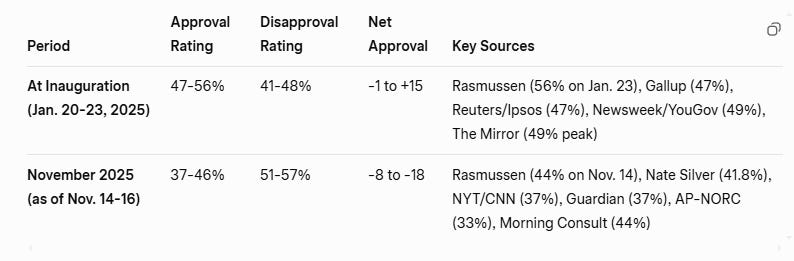
The drop is most pronounced among independents (-20+ points) and younger voters, with every state except Idaho shifting negative per The Economist. Rasmussen’s more conservative-leaning methodology still captures the erosion, with strong disapproval rising to 45%.
Trump initially enjoyed an unprecedented 60% approval rating among voters under 40 (per Rasmussen), but young voters are now reconsidering, with his support among those under 30 dipping below 40%. Folks expected a move toward economic populism, with young voters, in particular, rejecting corporatism’s erosion of capitalism. They anticipated accountability and reform—addressing issues like the weaponization of the justice system and an overreaching healthcare state—but have seen no progress on these fronts.
For most Republicans, it’s business as usual (so far) in Trump 2.0.
Younger voters enthusiastically supported DOGE’s aggressive dismantling of government structures, indicating their priority lies in transforming the system rather than sustaining the objectives of the international foreign policy establishment and the corporations that profit significantly from those aims.
Despite these issues, Trump’s approval rating remains higher than Biden’s was at this stage in his term, though Biden faced significant backlash from the chaotic Afghanistan withdrawal at the time.
Regardless of our personal views, it’s clear that many are dissatisfied with the perceived direction of this administration.
Authors Note - The following list reflects grievances voiced by certain factions of Trump’s base, not my personal criticisms. We don’t know the behind-the-scenes dynamics or the administration’s future direction. These concerns could well fade by the midterms. For now, I’m reserving judgment on most of these issues, as it’s been less than a year since the inauguration.
The factors fueling this decline and deeply dividing the base include:
Failure to Reduce Inflation and Deliver Affordability: Despite campaign pledges to “skyrocket incomes” and eliminate inflation, 19% of 2024 Trump voters disapprove of his handling of prices, with net approval dropping sharply. Voters report no real tax breaks or price reductions, leading to “buyer’s remorse.”
Overemphasis on Israel and Foreign Aid: A vocal subset of MAGA voters feels Trump has prioritized “Israel First” over U.S. interests, continuing funding for Gaza/West Bank operations and showing insufficient criticism of Israeli actions—alienating anti-interventionist supporters who expected an end to “Zionist wars.”
Ukraine and Russia: Some express disappointment in perceived softness toward Russia, allowing Putin “more of Ukraine” without strong pushback. Others think he’s being too soft on Ukraine, and are frustrated over its continued funding. More still are upset that he hasn’t made good on his promise of ending the war on “Day one” of his administration, though even he admitted he was being hyperbolic when he made those statements.
General Foreign Adventurism: Criticism for starting or escalating conflicts, importing Argentinian beef (hurting U.S. farmers), and inviting “terrorists” to the White House—seen as betraying isolationist promises.
Epstein Files: Trump’s reversal on releasing Epstein documents—calling supporters “weaklings” for demanding them—has fueled accusations of hypocrisy and cover-ups.
The H-1B fiasco: Some see H-1B’s as essential, while others see it as another betrayle of “America First,” insisting that America was leading in technological innovation long before the H-1B program was created.
Voters are also frustrated over the lack of progress on drilling and energy independence, pharmaceutical deregulation, and policies like 50-year mortgages and 15-year car loans, which are viewed as detrimental to workers.
I’m not highlighting these issues to sway opinions on Trump’s second term, but rather to outline the grievances I’ve observed, which must be addressed to prevent losses in the House and Senate during the midterms and to ensure success for the prospective 2028 candidate.
Things were already pretty convaluted and fragmented, but it’s gone into overdrive the last few weeks. Our own Jon Herold said it best:

“Can whoever removed a chromosome from MAGA this week put it back already?”
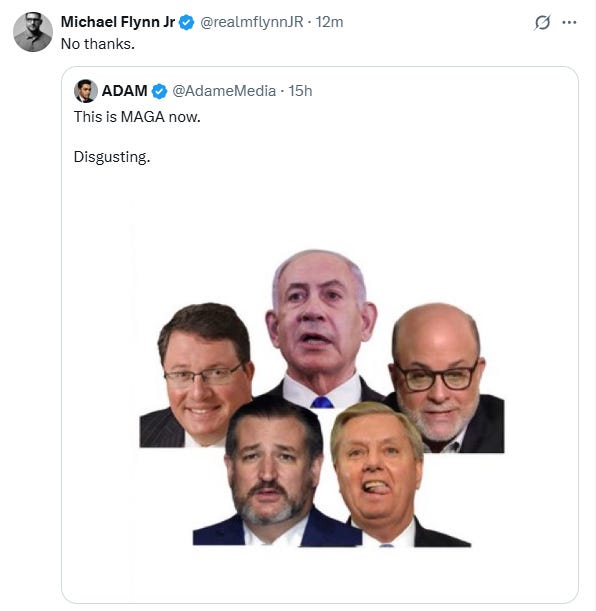
Flynn Jr—who has proven himself much more immune to partisan orthodoxy and blind allegiance than a vast majority of the “new media”—expressed what a lot of people are feeling.
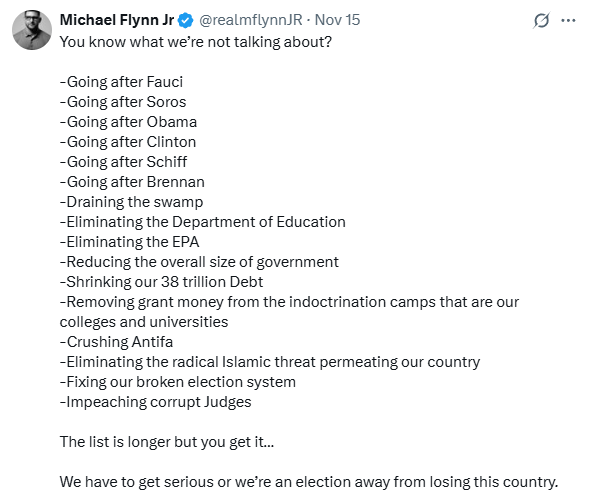
Trump, for whatever reason (and there are several theories), is increasingly moving away from his most stalwart supporters and allies, and moving closer to the those who’ve proven themselves to be conduits for the neoconservative agenda.
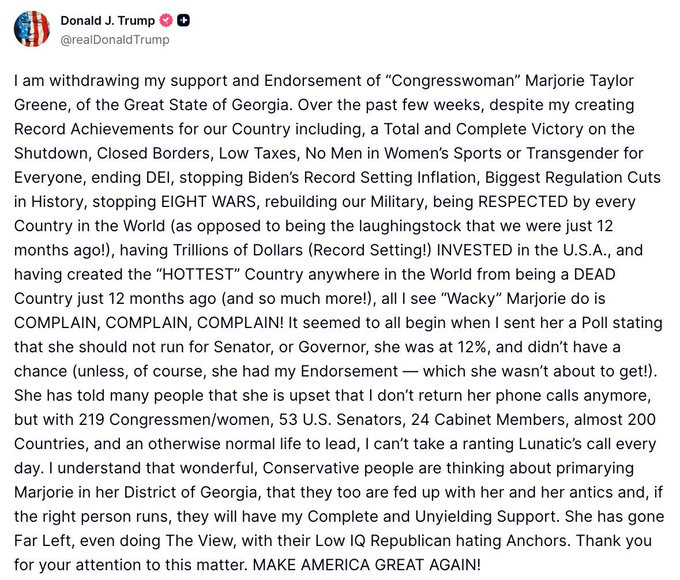
Jordan Sather has a compelling theory about the MTG/DJT fallout.
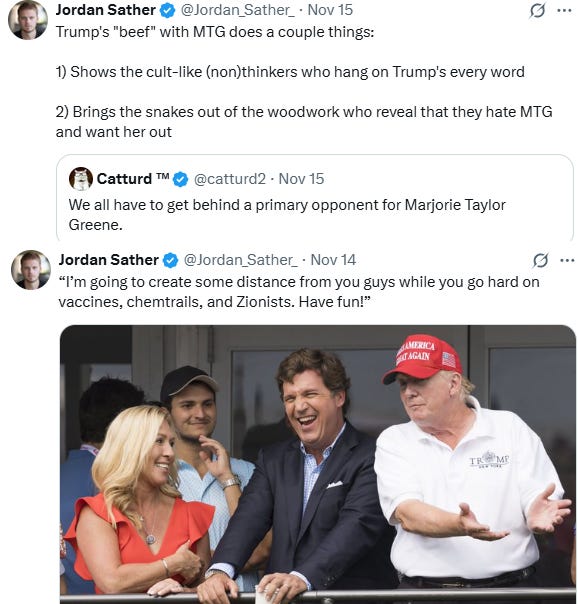
I’m not going to to tell you that this is an elaborate ruse and that Trump is secretly aligning with Tucker Carlson and Marjorie Taylor Greene, but I’m also not ruling out that possibility.
It’s possible that, for operational security, Trump is deliberately distancing himself from his biggest supporters to align with figures like Lindsey Graham, Randy Fine, and Mark Levin.
For my part, I still see the current situation as immensly preferable to a Kamala Harris presidency.
The Big Divide
If I had to dial in on one thing that I believe is causing the most friction among the Trump coalition, it would have to be foreign policy.
Trump, in all three elections, ran on a platform of ending all endless wars and reining in the neocons, the foreign policy establishment, and the military industrial complex. He chastized the Bushes, McCains and Cheneys, and the wars in Iraq and Afghanistan. This wasn’t the only thing that appeald to voters, but it was a big draw for many people.
Currently, Trump appears outwardly to be aligning more closely with establishment Republicans like Lindsey Graham while distancing himself from even mild critics of his administration.
This has produced two main interpretations within the base:
One view holds that Trump is simply drawn to whoever flatters him most and reflexively shuts out anyone who disagrees, regardless of their past loyalty.
The other sees it as a deliberate strategy: cozying up to the party establishment for political cover while sidelining voices associated with more controversial or politically risky positions.
One thing cannot be denied: Trump 2.0—at least outwardly—seems to be in lockstep with the neocons of yesteryear, the same neocons he campaigned against in 2016.
The primary architects of the U.S.-led forever wars of the 90s and 2000s belonged to The Project for the New American Century (PNAC), a neoconservative think tank active from 1997 to 2006, which played a significant role in shaping U.S. foreign policy.
This was the neocon hot bed during the both the Clinton and Bush Jr. administrations, from which all foreign policy of that era poured forth.
The fruits of this neocon think tank included: the invasion of Iraq, war in Afghanistan, the broader War on Terror doctrine, and providing diplomatic cover for Israeli military operations. They also called for war with Syria and Iran, objectives we still see being pushed by the foreign policy establishment in Trump 2.0.
The members of this think tank are remembered by those who were reporting at the time as the quintessential neocon warmongers. It just so happens that most of them had strong ties to Israel and helpped to reinforce the U.S. Israel relationship that is under such heavy scrutiny today.
Key members included:
William Kristol (Chairman, Co-Founder): A leading Jewish neoconservative, Kristol (son of Irving Kristol, a neocon pioneer) shaped PNAC’s vision through The Weekly Standard. His advocacy for Israel’s security was explicit, tying it to U.S. interests (e.g., 1996 “Clean Break” paper for Israel).
Robert Kagan (Co-Founder): Also Jewish, Kagan co-authored PNAC’s core documents, emphasizing U.S. hegemony and Israel as a democratic ally. His work with Kristol framed Middle East policy around countering Iran/Iraq threats. Husband of Victoria Nuland, who was Dick Cheney’s Deputy National Security Advisor at the time.
Paul Wolfowitz: A Jewish deputy defense secretary under Bush, Wolfowitz was a PNAC signatory and architect of the Iraq War, seen as partly benefiting Israel by removing Saddam Hussein. His 1990s writings prioritized U.S.-Israel strategic ties.
Richard Perle: A Jewish defense policy advisor, Perle co-authored the “Clean Break” paper and PNAC letters advocating regime change in Iraq. He was a vocal Israel supporter, framing it as a bulwark against terrorism.
John Bolton: a founding signatory and one of PNAC’s most prominent members. Unabashedly and consistently pro-Israel throughout his career—one of the most hard-line supporters in the neoconservative orbit.
Dick Cheney: After becoming Vice President in 2001, Cheney (along with Rumsfeld, Wolfowitz, and other PNAC alumni) effectively turned PNAC’s blueprint into U.S. policy, especially the 2003 Iraq invasion.
Others: Lesser-known Jewish PNAC members included Elliott Abrams (Middle East policy expert,) and Norman Podhoretz (neocon intellectual), both linking U.S. power to Israel’s stability.
Neoconservatism and Zionism are deeply intertwined, with little to no meaningful separation between the two.
I’m not taking a position on whether that’s good or bad—only noting that it appears fundamentally at odds with Trump’s stated commitment to ending forever wars and preventing new ones from starting.
One undeniable fact is that without the support of both Saudi Arabia and the right-leaning pro-Israel network—including the Netanyahu government, Miriam Adelson, the Republican Jewish Coalition, Bernie Marcus, and others—Trump’s second term probably wouldn’t have materialized. You may despise Israel, but if you backed Trump, you have to acknowledge that his victory hinged on support from the pro-Israel lobby and Saudi Arabia.
Pro-Israel donors provided a massive funding boost (over $200 million, including $100+ million from Miriam Adelson alone), which amplified Trump’s ground game in key states and helped solidify his appeal among Jewish and evangelical voters. Without it, the race could have been tighter, potentially costing him swing-state margins in places like Pennsylvania or Nevada, where Adelson’s influence (via her Las Vegas casino empire) was pronounced.
Contrarily, many argue this was “kayfabe,” believing that Trump courted donors with pro-Israel pledges (e.g., West Bank annexation hints), because without them, he’d lack resources to counter Harris’s $1B+ machine.
It’s a crucial point: that same pro-Israel financial and political machine—Adelson’s hundreds of millions, the RJC’s infrastructure, Netanyahu’s public and private endorsements—could very easily have been deployed against Trump if he had taken a less accommodating line on Israel.
In 2024, the moment a Republican candidate shows even modest daylight on Israel policy (settlements, Gaza operations, Iran confrontation), those dollars and that organizational muscle flip from ally to adversary almost overnight. We’ve seen it with Ron DeSantis in the primaries (initially courted, then quietly sidelined when he wouldn’t go all-in,) and with past figures like Pat Buchanan or Rand Paul, who were effectively frozen out of big donors and friendly media.
So the backing wasn’t just helpful—it was conditionally obligatory. Without signaling full alignment, that money and influence would have funded attack ads, rival super PACs, and a very different primary and general-election landscape. In that sense, the support was less a gift freely given and more a price of admission to remain viable on the Republican side in 2024.
Does this mean he’s captured?
Does this mean he is required to comply with all of their wishes?
I don’t think so, I don’t see Donald Trump as someone who would swear complete fealty to any power center. But he is indebted to these people, like it or not.
Whether or not Trump is forever and completely beholden to Israel, I cannot pretend to know, only that it is a tightrope he is going to have to navigate, and is one of several explanations for his complete reversal on Epstein transparency.
Most commentators and media consumers aren’t digging this deep. The majority simply want content that flatters their existing views and opinions, but that’s not how the game actually works.
The anti-war crowd was furious when Trump ordered strikes on Iran, and again when he sank boats allegedly carrying fentanyl (a pretext I personally find dubious), yet they rarely acknowledge that he stopped short of the full-scale, kinetic regime-change war in Iran that Israel—and the neocons—desperately wanted.
The notion that Trump is simply Netanyahu’s puppet is far too simplistic—it’s clearly a much more nuanced and complicated relationship than that.
Can the Divide be Bridged?
In my opinion?
Yes—but only if both sides are willing to treat the Israel/foreign-policy question as a policy disagreement rather than an identity-defining loyalty test, and only if Trump himself decides to use the enormous political capital he still possesses to force a real debate inside the movement instead of letting the loudest, richest, or most emotionally charged voices win by default.
Here’s how it could actually happen:
Reframe the debate from ‘Are you with Israel or against the Jews?’ to ‘What does America First foreign policy demand in 2026 and beyond?’ The minute the question becomes moral/religious/ethnic, the coalition dies. Keep it brutally pragmatic: dollars spent, body bags risked, strategic value gained or lost. That’s the language Bannon, Tucker, Navarro, Vought, and even many pro-Israel nationalists can actually negotiate in.
Trump has to publicly draw a line—and then enforce it. He still has the microphone no one else does. One prime-time speech (or even a series of Truth Social posts) that says something like: ‘I love Israel, I moved the embassy, I crushed ISIS, I made the Abraham Accords—but America First means NO American boys die for new wars in the Middle East, NO blank checks, and NO lobbying money buys my foreign policy. Period.’ That single act would instantly separate genuine America First nationalists (who would cheer) from pure neocons (who would seethe) and give cover to every populist-nationalist in Congress and media to start asking the hard questions again.
Maybe create an ‘America First Foreign Policy Council’ inside the White House or the RNC. Put Bannon, Tucker, Vivek, JD Vance, Russ Vought, and yes—even a couple of smart, realist pro-Israel voices like Jared Kushner or David Friedman—at the same table. Make them hammer out a written doctrine: where we stand with Israel, where we draw red lines, how we handle Iran, what ‘no forever wars’ actually means in practice. Publish it. If it would gain traction you’d likely see plenty of 2026 and 2028 candidates running on it. That turns a shouting match into a governing platform.
Depolarize the money. The pro-Israel donor class only has the power to kill the coalition because the populist side has no comparable funding base. Fix that. Trump could (and should) lean on Musk, Thiel, the Midwest manufacturing billionaires, and the crypto crowd to create a parallel ‘America First Super PAC’ that funds primary challengers against any Republican who votes for new Middle East wars or unconditional Israel funding. Once the money is balanced, the conversation changes overnight.
Stop the purity spirals on both ends. The groypers and neo-Nazis have to be dealt with in the public square, whether you like it or not. They may be a liability that hands the media and the neocons the perfect cudgel, but they are all mostly young, and no one continues to hold the political views they have when they are young throughout their entire lives. Today’s liability could be tomorrows voters. At the same time, the ‘criticize Israel and you’re an anti-Semite’ crowd has to be told—publicly and repeatedly—that policy criticism is not hate speech. Both moves reshape the Overton window back to something the coalition can actually live inside.
Give the base a win they can feel in their wallet. Nothing heals foreign-policy fractures like domestic success. If Trump (or the movement) can actually deliver lower grocery and gas prices and crush the deep/adminstrative/regulatory state with DOGE, a huge chunk of the disaffected youth and working-class nationalists will forgive a lot on the margins of foreign policy. Wins buy time; stagnation breeds civil war.
I’ll reiterate that I’m a bumbling philistine on a computer, and I have no idea if what I proposed would ever actually work, but we cannot simply comment on politics without ever proposing possible solutions.
I think we all tend to forget that.
It’s easier to to cheer or criticize policies, but the public needs to start thinking about solutions and advocating them rather than waiting for either faction of the ruling class to decide for them.
The hard truth: the divide can be bridged, but only from the top.
If Trump decides the coalition is worth saving and uses the next 6–12 months to draw clear lines, reward loyalty, and deliver tangible populist victories, the fractures can scar over. If he keeps drifting toward the Graham–Adelson axis and treats every critic as a traitor, the coalition will shatter—and 2026 will be a bloodbath.
The good news?
He’s done the impossible before. The question is whether he still believes the movement he built is bigger than any single donor, ally, or grudge.
Badlands Media articles and features represent the opinions of the contributing authors and do not necessarily represent the views of Badlands Media itself.
If you enjoyed this contribution to Badlands Media, please consider checking out more of Ryan’s work for free at the Post-Liberal.
Badlands Media will always put out our content for free, but you can support us by becoming a paid subscriber to this newsletter. Help our collective of citizen journalists take back the narrative from the MSM. We are the news now.
“Appear weak when you are strong…” Sun Tzu
Were the fake MAGA and the neo-con fake social media "influencers" ever really part of the America First coalition? Let them be exposed and discarded. The people are behind Trump.