
SMART Goal Setting in the Age of Election Corruption
A Measured Look At How to Reform Elections in as Little Time as Possible

Before I get started on the subject matter, I’d like to express my gratitude to the team for allowing me to guest author this post. In particular, has been very helpful in facilitating this entry. I’ve been appearing on Badlands Media shows since… well, as long as there has been a Badlands Media, but this is the first time I’ve contributed something in print for them.
My time fighting for election integrity, which commenced while President Trump was fighting to stay in office in November 2020, has been instrumental in shaping my view of the challenges ahead of us. I’ve been hit by nearly every mainstream media outlet there is (plus countless local outlets), spent over 500 days on the road, travelled through every state, and been called out by President Trump twice (I’ve also met him twice) in the last four years.
The feather in my cap came last November, when I predicted all 56 races for electoral votes (50 states, Washington, D.C., and the five split electoral votes of Maine and Nebraska) immediately following a New York Times feature piece that sought to cast doubt upon me and my methodology for being the only analyst out there in a sea of polling-obsessed blowhards blending traditional political measurements with my estimated capacities for election manipulation in each state.
One contributor to their exposé had inferred that I would only get any battleground state picks correct out of luck.
Luck be damned, given the significant crossover within pro-MAGA alternative media, many of you reading today certainly already follow my geopolitical journal, Captain K’s Corner, which is now one of the most widely read in its genre on the entire SubStack platform and lands in the inboxes of many people at the very top of the food chain when it comes to running the United States of America.
That journal serves as a massive archive of elections information, solutions, commentary, and assorted content one could spend weeks, if not months, perusing to piece together the full picture. My task here, given the truncated nature of my guest post, is to relay what I believe is the most effective way of reforming elections under President Trump with a realistic view of opposing factors and constraints, using George Doran’s SMART Goal Setting management model, which he created in 1981.
SMART Goal Setting considers five items when establishing goals. Goals are to be:
· Specific
· Measurable
· Achievable
· Relevant
· Time-bound
Starting from the bottom, one can already tell the clock is ticking on the 2026 midterms; in fact, one-eighth of the period between Trump’s election victory and the November 2026 races has already elapsed, and the boss has only been back in town for a little over three weeks.
Specific
Specificity requires an observer (in this case, the public) to understand the goal in definition and scope. Making things too complicated will create a problem set that cannot be solved within time constraints or the bounds of legality.
I believe a proper goal, in view of this, is:
Evaluate the system of elections for laws and conduct that disenfranchises voters of the state in question, and by default, voters of other states in national elections. Enact laws and procedures that provide transparency and fairness in elections and legally challenge all laws facilitating disenfranchising behavior with the full strength of the Department of Justice.
Measurable
After stating the specific mission and identifying a basic framework for success, quantifying and tracking the progress of the mission is the next step.
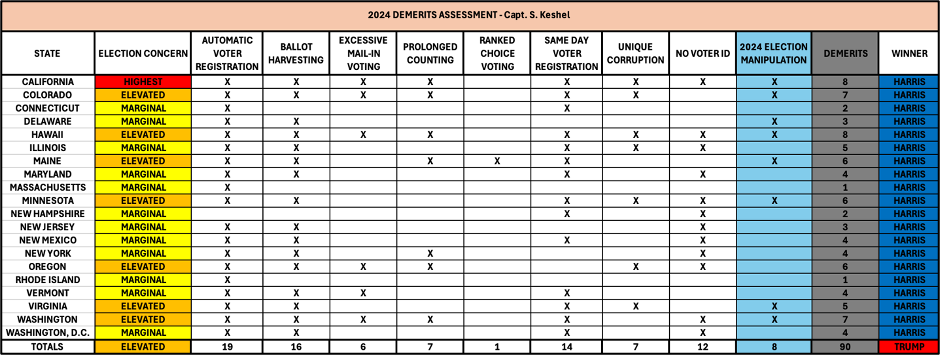
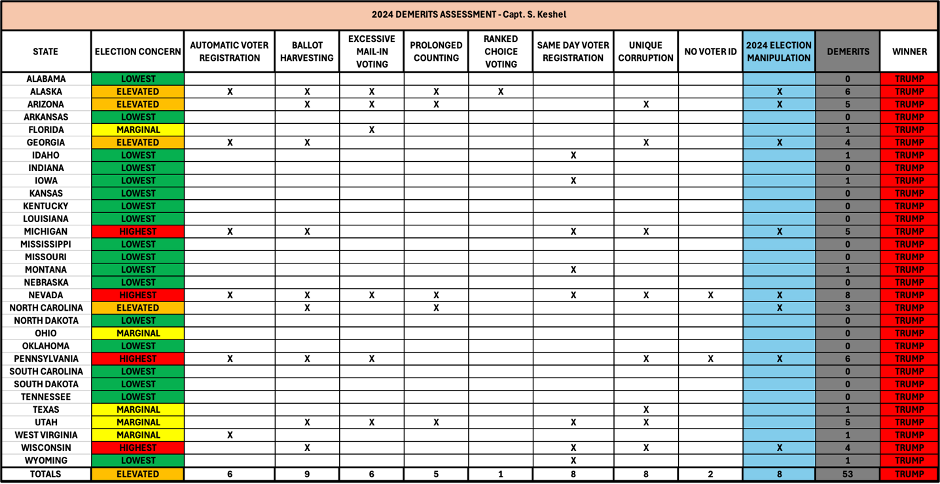
I have identified Eight Cardinal Sins of election administration from items that are not universally shared among all 50 states (such as the use of electronic voting systems, which are used everywhere):
· Automatic Voter Registration
· Ballot Harvesting
· Excessive Mail-in Voting
· Prolonged Counting
· Ranked Choice Voting
· Same Day Voter Registration
· Unique Corruption
· No Voter ID
You can read about the impact of these demerits on both blue and red states in my archives. If you ask me, I can give you plenty of reasons why the corruption of voter registration is the biggest indicator that a state will be a blue state in any given election:
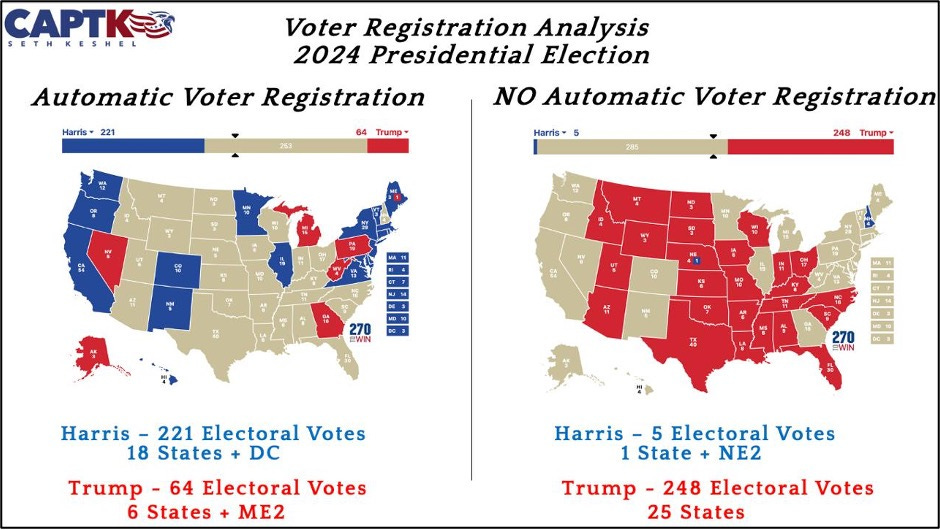
Therefore, to measure progress against these cardinal sins, we must be able to first identify where they are most concentrated, and work backward from there.
There are only so many categories of things that can go wrong in elections, and identifying them relative to other states is the key to success. This is measurable.
Achievable
Restraint is critical for solving this problem. I have identified three key pillars for President Trump to pursue, but ultimately, my end state foresees a much more complex system that takes much more work to install.
I’ve called it the Ten Points to True Election Integrity for three years:
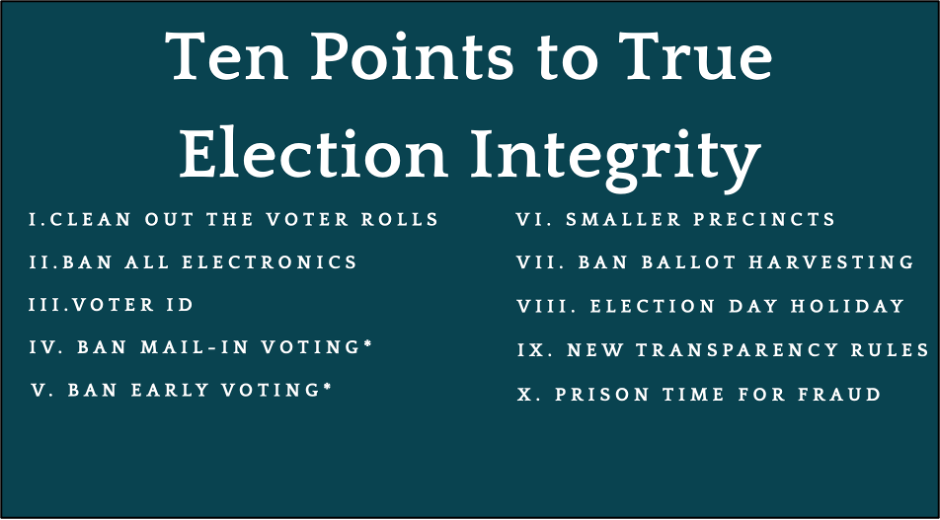
Again, the clock is ticking. I take flak from my own side for prioritizing the corruption of voter registration over machines, but you must remember that my approach is a pragmatic one that binds to the ugly reality rather than the fairy tale world of utopia.
While it is true some counties are working toward a paper ballot system, we are a long way from key counties in key states (the Maricopas and Fultons of the world) doing the same, and would need to replace these systems root and branch with a tested and proven hand counting system operated by efficient and precise personnel. There is a game changing hand count method out there, but we are running desperately low on time to change the way we run national elections with the next one just 21 months out.
With DOGE audits of every nook and cranny in Washington, D.C., underway, fields are ripe for moving forward on all this known election corruption. We are talking names, data, addresses, and records, here – in other words, a direct lineup with voter registration and its corrupted databases in every state.
My view of manual (not possible electronic) election corruption is as follows:
· Voter Registration is corrupted and done so most quickly when a state ushers in Automatic Voter Registration, which reduces the risk of getting caught performing registration fraud, since it is less crucial at that point.
· Expansion of mail-in balloting, ideally to universal method (every registration gets a ballot), as practiced in Washington, Oregon, California, and five other states.
· Legalization or non-penalization of ballot harvesting.
· Hiring of professional ballot collectors (harvesters) to collect mail-ballots, especially those landing in a designated location with no real recipient, but known by collection agents thanks to compromised and shared data.
· The key ingredient of time – more early voting, more time to get the ballots in.
Moving against these items is indeed achievable, as evidence of this corruption is now being widely publicized even in deep blue states. Here is a story of a woman in Bellevue, Washington, who received 16 mail ballots at her apartment.
Which do you think is more achievable?
· Displaying clear evidence of voter roll corruption from blue wall states that rely increasingly on Automatic Voter Registration and expanding mail-in balloting?
or…
· Convincing skeptics of election fraud theories that machines are flipping votes, when the only normie-proof argument against machines is that they don’t offer transparency or auditability?
Relevant
The relevance portion of SMART goalsetting requires the goal to be aligned with other objectives.
The early days of the Trump 47 administration have been wholeheartedly committed to gutting corruption and increasing transparency for the public, which to absolutely no one’s surprise, has been opposed by those who have enriched themselves at the expense of American citizen taxpayers.
Again, the goal:
Evaluate the system of elections for laws and conduct that disenfranchises voters of the state in question, and by default, voters of other states in national elections. Enact laws and procedures that provide transparency and fairness in elections and legally challenge all laws facilitating disenfranchising behavior with the full strength of the Department of Justice.
Our goal is relevant to the rest of the administration’s objectives to expose, reform, and subsequently overhaul the ineffective and corrupted ways of doing business in this country.
The electoral process is the most critical means of self-government in that our voices, clearly heard and honored, are all that stand between peaceful orderliness and chaotic upheaval, confirmable throughout the histories of all major nations and logged in the pages of your history books.
Time-bound
The key variable for us to navigate is the amount of time we have to make the specific, measurable, and achievable goal, which we have determined is relevant, come to fruition.
As stated earlier in this article, an eighth of the time between Trump’s election and his midterm evaluation has already elapsed. At the time of publication of this article (February 13, 2025), no Election Reform Committee has been announced, which would presumably isolate the vast sea of electoral problems into manageable chunks as shown above, and concentrate all available and legal executive powers into solving them.
If this committee were announced tomorrow and given 90 days to present solutions to President Trump, who may take a few weeks to peruse them, seek legal counsel, and then act, one might expect immediate restraining order requests and activist judge shopping to ensue, followed by stays and injunctions, all intended to push these matters to the Supreme Court:
· 90 Day Election Reform Committee Cycle
· 21 Days for Trump Deliberation and Executive Actions
· 90 Day Injunctions/Hearings
· 90 Days for Supreme Court to Take Up Appeal from Either Party and Rule
That runs us almost up to 300 days of total time, and I feel that I’m being somewhat conservative in my estimates, before swapping out bad systems for good can commence - which is yet another Herculean task to oversee.
300 days from today will be December 10, 2025, or less than 11 months from Election Day 2026, or even worse, less than 10 months from the start of the God-forsaken practice of Early Voting, which is intended to give enough time for harvesters to get all assigned ballots in a given precinct collected and turned in.
In short, the work to overhaul the 2026 elections on a grand scale must begin as soon as humanly possible; if it does not, we will immediately move on to discussing how to protect the 2028 presidential election and make it as free as possible from the chronic condition of electile dysfunction, which is characterized by four primary symptoms:
· Difficulty maintaining an election
· Election lasts for longer than four days
· Sudden severe and notable loss of interest in voting
· In worst cases, premature inauguration
Badlands Media articles and features represent the opinions of the contributing authors and do not necessarily represent the views of Badlands Media itself.
Seth Keshel, MBA, is a former Army Captain of Military Intelligence and Afghanistan veteran. His analytical method of election forecasting and analytics is known worldwide, and he has been commended by President Donald J. Trump for his work in the field.
His widely-read SubStack, Captain K’s Corner, can be found here:
Badlands Media will always put out our content for free, but you can support us by becoming a paid subscriber to this newsletter. Help our collective of citizen journalists take back the narrative from the MSM. We are the news now.
Seth, Please tell us that you are in communication with someone at Trump's administration to cut off the legs of this system of election fraud - before it happens again.
If not, I beg you to pound on the appropriate door until they accept your offer to lead the country in this fight.
Welcome aboard Seth!
Your expertise on this complicated subject is very much appreciated 🔥