
The Exploitation of Charlie Kirk
Guarding Your Emotions in a War Meant to Weaponize Them

September 11th has evolved into an unofficial American holiday, marked by its own traditions and ceremonies. Each year brings solemn commemorations, recaps of the day’s events, recycled memes, and familiar catchphrases like “America will never forget,” or “a nation stands united.”
I don’t typically participate in the annual wave of emotional appeals and pageantry that’s become a staple of corporate media and Con Inc pundits. Phrases like “never forget” don’t stir feelings of reverence or patriotism in me; instead, they spark feelings of disappointment, irritation, and even wry amusement.
What exactly are we meant to “never forget”?
Should we “never forget” the surfeit of low-effort lies our government fed us to advance the foreign policy establishment’s long-term goals?
Do we “never forget” how easily the public’s grief and rage was guided and politicized, and how Americans eagerly supported policies that would further erode our rights and privacy?
In retrospect, nothing beneficial to the public came out of the federal government’s response to 9/11. The political establishment, amplified by a compliant media, harnessed the nation’s grief and anger to manufacture consent for disastrous policies like the Patriot Act, warrantless surveillance under FISA, and the wars in Iraq and Afghanistan—all of which have had a corrosive effect on the public’s trust in Washington.
However, this year, 9/11 occurred in the immediate aftermath of Charlie Kirk’s assassination, and because of that, I have reconsidered my stance.
I am of the opinion that it is more important than ever to preserve the memory of the events of that day and the subsequent weeks and months.
The emotional tactics used in the wake of 9/11 are not relics of the past—they’re at work again today, in this moment, shaping our perceptions, whether we recognize it or not.
Now, more than ever, we must remember how our collective pain was weaponized to serve certain agendas, because it’s happening again.
In this piece, I want to observe and comment on all of the various forms of exploitation that I’ve witnessed over the last two weeks.
This exploitation isn’t just coming from one source; it is coming from a multitude of directions, including Benjamin Netanyahu and the State of Israel, leftist entertainers and organizations, the usual suspects in the GOP, and even elements within the Trump administration itself.
Netanyahu Speaks for Kirk
There’s a veritable stew of raw emotions in America right now on the heels of Charlie Kirk’s very public execution. It is yet another mass-trauma event that will anchor itself in the minds of the people who were there that day, and everyone who saw videos of Kirk’s blood spilling from his jugular spammed across their Twitter feeds from multiple different angles.
It is important to feel the emotions that well up inside of you when something like this happens, but within that storm of emotions comes the opportunity for outside forces to exploit them.
On that note, there is no one in the world who can compete with Benjamin Netanyahu when it comes to capitalizing on a tragedy.
He was quick to take advantage of the opportunity that arose in the aftermath of 9/11, effortlessly channeling the righteous indignation in America at the time in a direction that would further the foreign policy objectives of Israel. He directed this energy toward Saddam Hussein, a man who had no involvement in the September 11th attacks by appealing to emotion and spreading outright lies about weapons of mass destruction.
I don’t think anyone can argue that Netanyahu is the most adept foreign leader at manipulating American public opinion; it is something he has boasted about in the past:
“I know what America is. America is a thing you can move very easily, move it in the right direction. They won’t get in the way.”
This is the same man who has been desperately attempting to wrangle Trump into fighting all of his wars in the Middle East from the moment that his second term began—wars that Charlie Kirk was adamantly against, by the way, but we’ll get to that shortly.
Benjamin Netanyahu broke the sound barrier and set a new land speed record with how fast he began to insert himself into—and shape the narrative around—Charlie Kirk’s assassination.
First, he was all over Twitter, attaching himself to Charlie Kirk and depicting him as the ultimate supporter and loyalist of Israel.
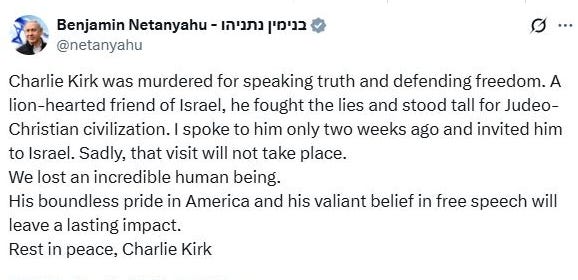
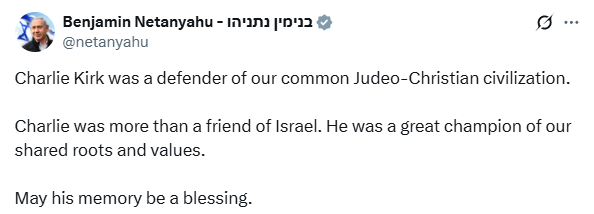
People were experiencing a lot of emotions that day; whether it was anger, sadness, schadenfreude, or even just fondly remembering what they perceived as the positive things about Charlie Kirk—all of that was now being associated with a pro-Israel stance thanks to Netanyahu’s messaging.
It’s the equivalent of saying, ‘Kirk loved Israel and was such a good friend to me, so if you feel things for Kirk then you should also love Israel like he did and trust me implicitly.’
It wasn’t just a couple of tweets, either. Netanyahu made multiple appearances on corporate news media and podcasts that week.
He went on Fox, a network whose audience is particularly susceptible to Netanyahu’s brand of emotional appeal, to further graft himself and his goals onto Charlie Kirk’s memory.
In the video, Netanyahu assures you that he is a human before mentioning his new favorite prop, a letter written to him by Charlie back in May of this year. He then precedes to blur the lines between modern American progressivism and Islam—two things that are fundamentally incompatible despite the West’s attempts to manipulate the culture.
Of course there wasn’t even the slightest attempt to practice journalism, no probing questions or pushback. it was the standard Netanyahu treatment really: ask the pre-approved question, tee him up, let him let him say whatever he wants while nodding in agreement.
It’s no surprise that Harris Faulkner, one of Fox News’ most seasoned talking heads, led this segment.
It was Faulkner, with her signature scowl and dead stare, who hosted Condoleezza Rice to discuss war crimes following Russia’s invasion of Ukraine.
The irony of this clip should not be lost on this audience.
This is Fox News, the network that most fueled support for the “War on Terror,” gave a platform to the former National Security Advisor—who played a central role in overseeing the U.S. invasions of Iraq and Afghanistan—to lecture us on how it’s considered a war crime to invade a sovereign nation.
For someone so concerned about war crimes, Faulkner was awfully mum about them while hosting Netanyahu.
Next, he would go on Newsmax, once again invoking this letter that Kirk allegedly wrote to him in May.
Now, there’s scuttlebutt circulating from people who were close to Charlie that this letter was wildly distorted and taken out of context—I don’t know if that’s the truth, but making the letter public would go a long way to dispelling those accusations.
You’d think that Netanyahu had all the free time in the world to dedicate so much time to inserting himself into the Kirk discourse. He prioritized this despite being engaged in conflicts on multiple fronts while combating his own spate of legal and political crises at home.
The most pressing thing for this foreign leader to do last week was to cement the association between himself and Charlie Kirk in the collective American mind. It is important that we all ask ourselves why that is.
For decades, a thriving career in media or politics has often demanded outspoken and unwavering support for Israel. Yet, exceptions like Pat Buchanan, Ron Paul, and John Hostettler have defied this expectation, openly criticizing U.S.-Israel policy.
Taking such a stance is fraught with risk, as challenging Israel and its powerful lobby can derail a career—just look at Earl Hilliard (D-AL), Cori Bush (D-MO) and Jamaal Bowman (D-NY), each of whom lost their seats after significant backlash from pro-Israel groups.
The same is true in the media space.
However, in recent years portions of the right, especially the younger generations, have been fracturing on U.S.-Israel policy.
Turning Point had increasingly become the primary locus where this debate between Israel loyalists and Israel scrutinizers was taking place.
Charlie Kirk loved Israel, but, believing in the importance of debate, he was actively providing a platform for respectful dissent on US-Israeli relations.
He recently platformed two well known individuals who have both vocally criticized the current configuration of Israeli/American relations: Tucker Carlson and David Smith.
Tucker Carlson, already a polarizing figure among staunch Israel supporters, intensified their criticism with his July 2025 speech at Turning Point USA’s Student Action Summit (SAS) in Tampa. He suggested a link between Jeffrey Epstein and Israeli intelligence (Mossad) and raised concerns about American citizens serving in foreign militaries, specifically mentioning the IDF.
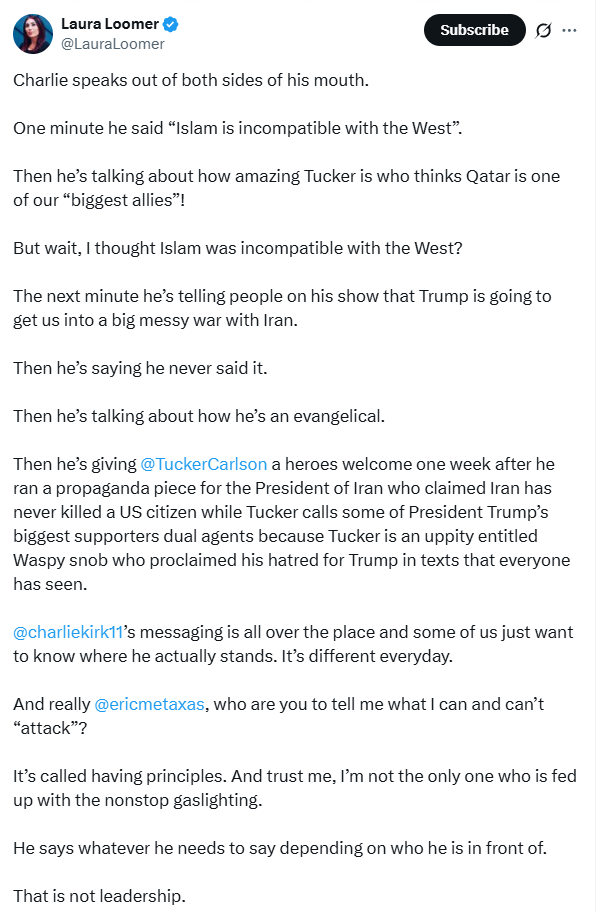
This sparked fierce backlash from figures like Laura Loomer and organizations such as StopAntisemitism, who accused him of promoting antisemitic tropes.
But Kirk defended Carlson.
The same event hosted a debate between libertarian comedian Dave Smith and Josh Hammer. Kirk and TPUSA would also catch flack for this.
Despite having completely different opinions on a wide range of topics, Dave Smith and Tucker Carlson have now been derogatorily branded as the “woke right,” a term used to demarcate and dehumanize anyone who doesn’t faithfully follow the script on Israel.
These sentiments were not only coming from Tucker Carlson and David Smith, but many of the young men who fill the ranks of Turning Point as well.
Listen to this recent exchange:
... If you call everyone an anti-Semite if they don’t take a puritanical view of the Netanyahu Government then I think that’s bad for everybody.
Kirk was not an enemy to Israel, but he did not follow the script. His comments opposing U.S. involvement in a potential war with Iran, warning against another costly conflict, prompted backlash from pro-Israel influencers and donors who pressured him to align with their stance.
The usual suspects who police all conservative opinion RE Israel were out for blood.
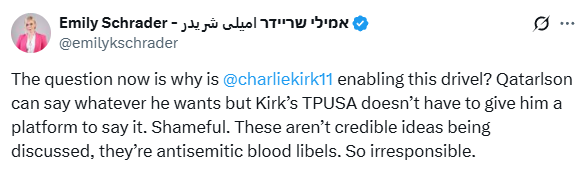
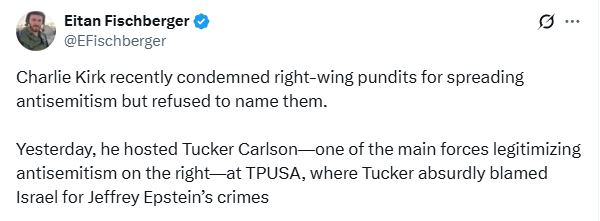
Kirk appeared on Megyn Kelly’s show earlier this year, where they both voiced shared frustration over the heavily policed discourse surrounding Israel in America.
… I feel the connection to Israel, but, at the same time, simultaneously, when the hostile reaction is that now Megyn and Charlie are now enemies (of Israel)? Man, I tell ya, you’re going to weaken... I’m not going to say lose, but you will weaken and just basically deflate two of your strongest advocates if that continues.
This was Charlie’s disposition towards the increasingly pushy pro-Netanyahu thought police in the months before his murder.
He loved Israel, but was clearly growing weary of the constant tightrope that he had to walk, and—being somebody who prides himself on telling the truth—he vocalized that weariness both on and off camera.
Following Kirk’s death, Tucker Carlson appeared on Megyn Kelly’s show to discuss what he understood to be Charlie Kirk’s true feelings and the growing pressure he faced from some TPUSA donors who disapproved of his moderate stance on Israel.
… he took massive, MASSIVE abuse from his own donors… but he loved his donors, I don’t think it was a hostile thing but they had a different view—a lot of them, not all, but a lot—and they expressed it to him in a very intense way.
I know because he showed me …
There’s still a lot of lingering questions about Charlie’s murder, and when you consider that Americans and our government have no real interest in learning or exposing what really happened on 9/11, I tend to doubt that we’ll ever get any real clarity on whatever went down behind the scenes with the Kirk assassination.
Needless to say, Kirk was a prime target for the enemies of populism.
No one person in the big-tent coalition that got Donald Trump into office this time around was as influential and effective as Charlie kirk.
Elon Musk spent a considerable amount of money and freed Twitter from establishment control, Scott Pressler registered countless voters, but it was Charlie Kirk who reshaped a generation, whether you are a fan of his or not.
What he did with the youth vote will have lasting consequences on elections well into the future.
In my opinion, if there was anyone in the MAGA movement that was on track to becoming president one day, it was Charlie Kirk.
Trump Admin’s Troubling Posturing
Whether it is an intentional or conscious effort, the Trump administration’s response to Kirk’s murder—at least initially—has been troubling.
In the first half of the video below, Trump thoughtfully addresses the tragic murder of Charlie Kirk and honors him with kind words, but halfway through, the focus shifts, and Trump himself sets the tone for what has since spiraled into the right’s own brand of cancel culture and calls for repressive measures.
This idea that villainizing your political opponents makes you responsible for any violence directed at them is exactly the same sentiment used by the establishment Left—not just in America, but across the broader West—to justify censorship measures against conservatives.
The term “hate speech” became popularized in both the political establishment and in the modern liberal vernacular.
We were told that words can cause psychological damage and that the government should be allowed to step in and protect us from certain speech and opinions. Conservatives who once scoffed and laughed at this concept are now openly embracing and advocating for it.
Related - A Glaring Double Standard
Are we going to pretend that the right doesn’t also demonize their political opponents?
In the same way that the left invokes the words “Nazi” and “Fascist,” I cannot count how many times I’ve seen Democrat politicians referred to as “Marxist” or “Communist.”
I’ve seen the left regularly described as being “demonically possessed.”
Isn’t that as literal of an example of “demonizing” as it gets?
I’m not saying this just to poo poo conservatives nor am I saying this to defend the left; I’m just trying to keep the focus—as we always have here at Badlands—on the unparalleled importance and sanctity of our right to free speech.
Disparaging remarks, stereotyping and conflating the views of an extremist few with an entire demographic is just part and parcel to modern American politics.
Since Kirk’s death, we have seen the following:
The State Department announced it would revoke visas for non-citizens whose social media posts "celebrate" Kirk's death.
The Pentagon "tracking" and "addressing" federal employees (e.g., service members) who mock or celebrate the killing, with Defense Secretary Pete Hegseth calling such speech "unacceptable."
Attorney General Pam Bondi stated the Trump administration would "target" and "shut down" "hate speech" related to Kirk, later clarifying it refers to threats of violence, but initially suggesting broader application (e.g., prosecuting a print shop employee for refusing to print memorial flyers).
Reports that the White House is drafting an executive order for President Trump to "combat political violence and hate speech," aiming to expand federal oversight of online rhetoric blamed for inciting the assassination. Naturally, you have critics, like Tucker Carlson warning that it could lead to broader hate speech restrictions, which contradict Kirk's own advocacy for unrestricted speech.
Over 36 professors, teachers, and public employees have been fired or investigated for social media posts disparaging Kirk or "celebrating" his death (e.g., Ball State University fired an employee; multiple Indiana teachers were removed).
Vice President JD Vance urged Americans to report individuals to their employers. Right-wing groups launched doxxing efforts, including a now-defunct website ("Expose Charlie Murderers") that received 40,000 submissions with names and workplaces. [I'm not commenting on the legality of this. Private companies have broad leeway to terminate at-will employees for off-duty speech.]
You might agree with most of these measures, and some of them might actually help with the impending ANTIFA scuffle that looms on the horizon, but I ask that you consider how this same rationale has and will again be used against conservatives.
Unlike post-9/11 expansions (e.g., PATRIOT Act), these are ad hoc and enforcement-focused rather than sweeping new laws.
However, the executive order could evolve into something more repressive if implemented.
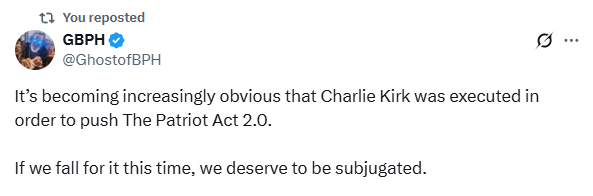
Our own
summed it up nicely:“It’s becoming increasingly obvious that Charlie Kirk was executed in order to push The Patriot Act 2.0.
If we fall for it this time, we deserve to be subjugated.”
I’m not trying to say that Donald Trump and his administration are intentionally helping to further the goals of a “deep state” or the financial elite who steer the international rules-based order, that would be just as dishonest as saying that anyone who initially supported the War on Terror in the immediate wake of 9-11 was a willing shill for the Military-Industrial Complex.
What I’m suggesting is that no regime is perfect, and that when emotions are high, mistakes are often made.
But maybe it’s not a mistake.
When viewed through the lens that everything we are witnessing is one big war of stories—to borrow terminology from
—it’s possible that these measures are being taken to draw peoples attention to something, and to give the left a taste of its own medicine (the voters, not the players) so that in the future they won’t be so quick to embrace censoring their opponents, and will be able to see the hypocrisy in it.The assassination of Charlie Kirk has ripped open old wounds, exposing the same playbook of emotional manipulation we saw after 9/11.
Grief, anger, and fear are once again being weaponized to shape narratives and push agendas—whether by foreign leaders like Benjamin Netanyahu, who grafted Israel’s interests onto Kirk’s memory with dizzying speed, or by domestic actors across the political spectrum, from leftist entertainers to GOP stalwarts, and even elements within the Trump administration.
Each is exploiting this tragedy to advance their own ends, and we’re falling for it again.
Netanyahu’s media blitz—tweeting, waving a dubious letter, and charming Fox News—wasn’t about honoring Kirk. It was about cementing an association: love Kirk, love Israel, trust Bibi.
Meanwhile, the left’s sanctimonious outrage and the right’s calls for censorship mirror the post-9/11 rush to sacrifice liberty for security.
This isn’t about denying the pain of Kirk’s death or the need for justice. It’s about recognizing how that pain is being hijacked, just as it was after 9/11, to silence dissent and tighten control.
Kirk himself, despite his flaws, stood for open debate, platforming voices like Tucker Carlson and Dave Smith, who challenged the sacred cows of U.S.-Israel policy.
We must honor Kirk’s legacy not by cheering censorship or rallying behind foreign agendas, but by fiercely guarding the right to speak, question, and criticize—no matter who it offends.
The job of a free people isn’t to blindly trust power, whether it’s Trump, Netanyahu, or the media machine. It’s to hold it accountable, especially when emotions run high.
If we forget that lesson, we’re not just betraying Kirk—we’re betraying ourselves.
Badlands Media articles and features represent the opinions of the contributing authors and do not necessarily represent the views of Badlands Media itself.
If you enjoyed this contribution to Badlands Media, please consider checking out more of Ryan’s work for free at the Post-Liberal.
Badlands Media will always put out our content for free, but you can support us by becoming a paid subscriber to this newsletter. Help our collective of citizen journalists take back the narrative from the MSM. We are the news now.
I agree with your larger point regarding censorship. When Trump was removed from Twitter was when I knew we were in trouble. That was my wake-up call. But I don't agree that Trump was calling for censorship of the left. I believe Trump was calling for "Rule of law" and the accountability that it delivers. I do agree that others in the administration seemed to fall in the "Hate Speech" trap. I would call it Trump quicksand.
I don’t go as far as to say the assassination was fake nor was Charlie fake. It appears what comes after is manipulated into a narrative that suits their needs. It gets capitalized upon and that part makes it feel cheap and fake.