
Badlands Brief
Crypto Smears, Professional Plotlines, & Meat Probes

The Badlands Brief is your daily drop of Badlands’ takes on the narratives dominating the info war. Read on, and join the conversation in the comments section.
New Witness Tied to Russian Interference Assessments Emerges in Durham-Era Fallout
A newly disclosed witness involved in US intelligence assessments on Russian election interference in 2016 and 2020 has come forward to congressional investigators, adding another layer to ongoing scrutiny of the origins and handling of the Trump–Russia probe.
According to reporting from Just the News, the individual — described as having knowledge of intelligence community processes tied to Russia-related findings — has provided information to lawmakers examining how assessments of Russian interference were developed and communicated.
The broader inquiry traces back to the FBI’s 2016 counterintelligence investigation, known as Crossfire Hurricane, and subsequent reviews including Special Counsel John Durham’s probe into the origins of that investigation. Durham’s final report, released in 2023, criticized aspects of the FBI’s handling of intelligence but did not establish a criminal conspiracy involving senior officials.
US intelligence agencies previously concluded that Russia interfered in the 2016 election primarily through cyber operations and influence campaigns aimed at undermining confidence in the electoral process and harming Democrat candidate Hillary Clinton. Those findings were supported by the intelligence community at the time, including a 2017 Intelligence Community Assessment.
“Gavin Wilde, who now works at think tanks in the nation’s capital, co-authored the flawed January 2017 intelligence community assessment on Russian meddling in the 2016 election prior to serving on the Trump National Security Council in 2018 and 2019,” Just the News reported Monday. “And he has also said that he worked on U.S. intelligence assessments on alleged Russian influence efforts ahead of the 2020 election as well.”
Wilde was previously referred to as “Witness 2” in the Ukraine impeachment documents.
Ashe in America: This seems significant. The co-author of the 2017 intelligence community assessment – part of Crossfire Hurricane – is reportedly now a witness for the government in the “treasonous grand conspiracy” against President Trump in the wake of the 2016 election.
She was never supposed to lose.
The witness, Wilde, was also involved in the Ukrainian impeachment, according to the reports. I wonder how long he’s been working with the justice seekers. He’s newly disclosed, but is he newly flipped? Doesn’t sound like it.
Rather, it sounds like the guy who was hands on keyboard in multiple overt acts is a cooperating witness, and given the speed of disclosures now, I reckon he has been for a bit.
“The 2019 claims by Witness 2 were critical in helping Intelligence Community Inspector General Michael Atkinson push Ukraine whistleblower Eric Ciaramella’s complaint forward, and Wilde’s ‘Russiagate’-linked biases were concealed from House investigators during the impeachment process.”
Yikes. Kash Patel discussed that obstruction in Government Gangsters. This has all the classic earmarks of a justice phase, doesn’t it?
So, who was giving Wilde orders from 2017 to 2019?
“The Intelligence Community Assessment was written at the direction of then-President Obama and largely overseen by then- FBI Director James Comey, former CIA Director John Brennan and former Director of National Intelligence James Clapper.”
Accelerate.
Europe Warns of Tight Fuel Supplies Amid Market Strain and Policy Divisions
European officials and energy analysts are warning of tightening fuel supplies across parts of the continent, citing market disruptions, refining constraints, and ongoing geopolitical tensions affecting global oil flows.
Recent reporting highlights concerns that inventories of refined fuels — including diesel — are under pressure, with some experts warning the risk of shortages is elevated if supply disruptions continue. Trading analysts point to constrained refining capacity, shipping bottlenecks, and instability in key transit routes as contributing factors.
At the same time, policymakers and industry voices have acknowledged gaps in visibility over real-time fuel inventories, particularly across fragmented national storage systems, complicating coordinated responses. While Europe maintains strategic petroleum reserves, tracking accessible and refined fuel supply remains more complex than crude stockpiles alone.
The debate is further complicated by political divisions over energy policy. Some officials, including allies of Italian leadership, have called for reconsidering restrictions on Russian energy imports to stabilize supply, while others argue Europe still has access to sufficient resources but faces policy-driven limitations on production and usage.
Analysts emphasize that the issue is not a complete absence of oil, but rather a combination of logistics, refining capacity, and policy choices that could lead to localized shortages or price spikes if conditions worsen.
GhostofBasedPatrickHenry: Two weeks ago, IEA (International Energy Agency) executive director Fatih Birol said that Europe had about six weeks supply of jet fuel before they would begin to see shortages.
Europe is now staring down a bleak abyss, as it refuses to develop its own oil or gas industries, and refuses to buy from its next door neighbor: Russia.
President Trump actually warned [German Prime Minister] Angela Merkel and the Europeans about this precise predicament back on June 9, 2018, at the Group of Seven (G7) summit in Canada. You may recall this moment thanks to the meme that came out of it.
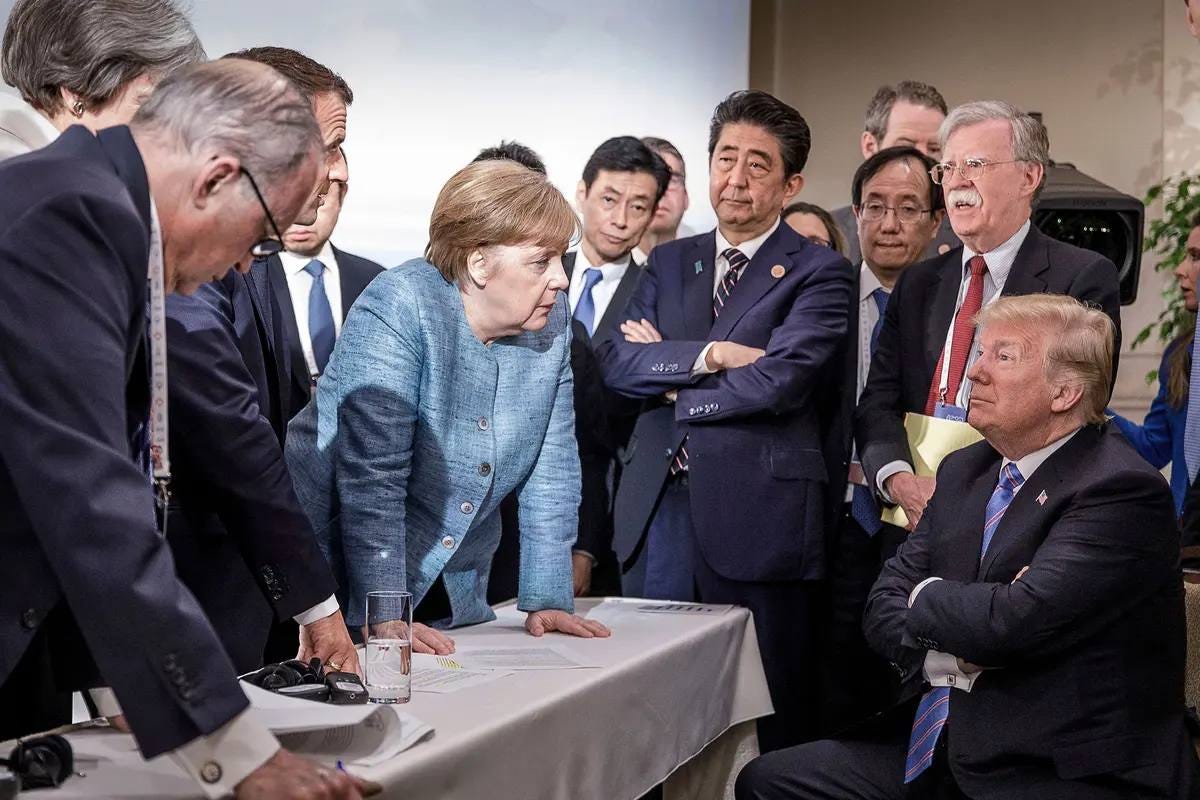
President Trump accurately pointed out the absurdity that the US taxpayer be asked to the fund the military defense of a foreign continent, when everybody on that continent is dependent on the supposed nemesis for energy. It is absolutely retarded, the more you think about it. In fact, it’s so retarded that most people would probably dismiss it as Russian propaganda.
How could any government be this stupid? End your own energy program? Become dependent on your neighbor? Then provoke a kinetic conflict with that neighbor? And expect another foreign country to fund your defense?
And yet, these European elites have done all of this to themselves.
MEWE: The Privacy-First Social Network
Tired of censorship, shadow-bans, and algorithms deciding what you can say? Join mewe — the privacy-first social network where real conversations and free expression come first.

Trump’s Project Freedom Results in Monday Chaos That May or May Not Be Real
President Donald Trump announced a new military operation dubbed “Project Freedom” aimed at reopening the Strait of Hormuz and escorting commercial vessels through the critical global shipping lane, as clashes with Iranian forces escalated Monday.
US naval and air assets engaged Iranian drones and small boats near the strait, destroying multiple vessels while attempting to secure safe passage for commercial shipping. The operation is intended to move stranded ships through the waterway, which handles a significant share of global oil traffic.
Iranian state-linked sources claimed their forces struck a US warship during the confrontation. The Pentagon rejected that assertion, stating no American vessels were hit and that US forces successfully repelled the attacks.
Reports from the region indicate that some commercial ships were damaged or targeted during the exchange, while others were able to transit under US protection. The situation remains fluid.
Burning Bright: Trump’s ‘Project Freedom’ deployment is kinetic-adjacent in presentation, yet primarily narrative in function, and it forces every other actor to orient around a new baseline Trump has authored.
The Media Apparatus, for its part has grown increasingly candid that the Actuals on either side cannot be independently confirmed at the speed of the story cycle, and that even official confirmations arrive already shaped by the propaganda requirements of fifth-generational conflict.
Whether or not specific strikes, interceptions or transits occurred exactly as described, they are not occurring for the reasons most immediately offered, nor are they unfolding in isolation from the larger information contest.
These admissions are quiet, but cumulative: the war we are shown is not the war that is being fought, and the reasons we are given are rarely the operative ones.
While the Iran War is the current Story on display, this is a First Principle when it comes to observing the Narrative Wars that have preceded and largely come to define virtually all global conflicts in recorded hi(story.)
Psychological orientation in this environment therefore shifts from the increasingly futile question of ‘What is happening?’ to the more durable question of projected end states.
When Trump deploys Project Freedom, what outcome is he steering the world toward?
A tactical restoration of commercial movement that relieves pressure on global energy flows while preserving room for negotiated de-escalation?
A broader demonstration that the old chokepoints can no longer be held by any single actor without incurring unsustainable narrative and material costs?
A public signal, legible to both domestic and multipolar audiences that the United States under his direction will not be drawn into the perpetual conflict trap the previous paradigm required to sustain itself?
Each of these possible end states carries different implications for how counter-narratives from media and institutional voices will be structured in response—narratives that typically emphasize escalation risk, the recklessness of Trump’s moves or the inevitability of wider entanglements on the back of them, all of which serve to defend the legitimacy of the rules-based order even as its enforcement mechanisms visibly fray under Trump’s (and yes, the Iranian Regime’s) sustained and coordinated pressure campaign.
The same lens applies to the Iranian side.
Their narrative deployments—warnings of forceful responses to interference in a redefined maritime regime, claims of successful strikes met with immediate Pentagon rejections, insistence that any American action constitutes ceasefire violations—project an end state in which external powers are compelled to treat Iranian red lines as operational realities rather than rhetorical posturing.
Whether that posture is ultimately sustainable or whether it functions as calibrated pressure within a larger bargaining sequence is precisely what the story war obscures, for now.
Either way, what is becoming unmistakable is that Trump has elected to raise the temperature on the Global Battlespace rather than continue the slower boil.
In-Person & Virtual Tickets to GART 12 in Deadwood — On Sale Now!
Badlands Media hits the road four times a year for a 3-day patriot-packed event with our hosts and the Badlands community. Meet like-minded Americans, hear powerful content, and be part of something real.

NATO Engages Film Industry on Communications Strategy as Trump Weighs European Troop Drawdowns
NATO officials held discussions with film and television industry representatives as part of broader efforts to shape public understanding of the alliance’s mission, as tensions grow over potential US troop reductions in Europe under President Donald Trump.
NATO sources describe the engagement with media creators as part of strategic communications and public outreach, a practice common among governments and defense alliances seeking to explain policies and maintain public support. Critics, however, have characterized the effort as an attempt to influence narratives through entertainment media.
At the same time, Trump has signaled he is considering reducing or repositioning US military forces stationed in parts of Europe, including Spain and Italy, amid ongoing disputes over defense spending and alliance burden-sharing. The potential shift has raised concern among European leaders about regional security and alliance cohesion.
Italian Prime Minister Giorgia Meloni said she would oppose any unilateral US troop withdrawal from Italy, underscoring reliance on the American security presence. Other European officials have similarly warned that a drawdown could weaken deterrence at a time of heightened geopolitical tensions.
Reports also indicate internal disagreements within NATO over strategy and posture, with some members urging stronger collective defense commitments while others navigate political and economic constraints at home.
The situation reflects a broader moment of strain within the alliance, balancing public messaging, military posture, and political divisions as the United States reassesses its role in European security.
GhostofBasedPatrickHenry: Oh boy, prepare for at least a few movies over the next few years that will glorify NATO while vilifying Russian. (Perhaps it will be a comedy.)
As for President Trump’s posturing to leave NATO: Interesting timing; Right as Europe faces a jet fuel shortage and an overall general energy crisis.
Just as I think Trump is motivating European countries to restart/redevelop their oil sector, he is also motivating them to establish their own national defenses. As the US scales back the funding and manpower of NATO, those defenses will become a major necessity.
The Europeans could just buy oil and gas from Russia. But NATO makes that complicated, as it has become clear that the organization only exists to combat Russia.
… but they could still do it. All they have to do is abandon Ukraine and let the Russians deal with Zelensky.
Justice Department Ramps Up Antitrust Probe into Big Four Beef Packers
The Trump administration’s Departments of Justice and Agriculture announced an intensified antitrust investigation into JBS, Cargill, Tyson Foods, and National Beef, citing price manipulation, foreign ownership risks, and supply chain issues.
Acting Attorney General Todd Blanche revealed reviews of over three million documents and hundreds of rancher interviews, while Agriculture Secretary Brooke Rollins called foreign-owned packers like JBS and National Beef a national security threat amid reports of slave labor ties.
“Half of these meatpacking giants, including the largest meat packer in the world, are either foreign-owned or have significant foreign ownership and control, making them a threat not just to our cattle producers, but a threat to America itself,” Secretary of Agriculture Brook Rollins said Monday.
The probe follows Trump’s November 2025 directive and ties into a coming settlement on poultry and meat prices, as US beef herds hit 1950s lows due to droughts and declining ranch numbers.
Ashe in America: “The Department has executed on [the President’s] Executive Order to stop anti-competitive behavior in the broader food supply market. Later this week, we’ll be announcing a historic settlement that will directly affect the prices of proteins like chicken, pork and turkey.”
To recap, there is an immediate settlement coming that promises to lower US meat prices; there are ongoing investigations where the department is seeking the help of whistleblowers to combat the impacts of globalism (and its collusion) on the US agriculture industries; and Big Ag was just named a threat to America itself.
Can’t wait for the Blanche doomer spin on this one.
BONUS ITEMS
Trump-Linked Crypto Firm Sues Justin Sun Over Alleged Smear Campaign
World Liberty Financial, a cryptocurrency venture co-founded by President Trump and his sons, filed a defamation lawsuit Monday against crypto billionaire Justin Sun, accusing him of launching a coordinated effort to damage the company’s reputation.
The complaint, filed in Miami-Dade County, Florida, seeks unspecified damages and a public retraction over statements Sun made on social media.
World Liberty alleges Sun bet against its $WLFI token and used third parties to conceal purchases, while the company moved to freeze assets tied to one of his firms. The filing claims Sun responded with a “scorched earth” campaign, including threats of litigation and public attacks after the company refused his demands.
The suit further accuses Sun of spreading false claims about the company’s operations, amplifying them through influencers and bot accounts, and generating millions of views that caused significant reputational harm. Sun, founder of Tron, has not publicly responded to the allegations.
Please share the Brief far and wide! Want to join the conversation? Jump in the comments and let us know your thoughts. And if you like the Substack, you should check out our shows — streaming now on Badlands Media!
The opinions expressed in the Badlands Brief are those of the tagged authors and do not necessarily reflect the attitudes or positions of Badlands Media.
The Brief is free, but you can support us by becoming a paid subscriber to help our collective of citizen journalists take back the narrative.
Europe's leadership today resembles the clueless heirs who inherited Jed Starnes' 𝙏𝙬𝙚𝙣𝙩𝙞𝙚𝙩𝙝 𝘾𝙚𝙣𝙩𝙪𝙧𝙮 𝙈𝙤𝙩𝙤𝙧 𝙁𝙖𝙘𝙩𝙤𝙧𝙮* - raised in unearned luxury, ignorant of the hard work and careful planning that created their ease, and ultimately unqualified to maintain it. As in Starnesville, economic devastation followed and spread far and wide.
* "Atlas Shrugged," of course
Thanks Badlands!
Limited resources demand prioritization.
Limited resources determine values - in both an economic and sociological sense.
The limits on resources should never come as a shock...and yet...
It seems that the choice to refuse to prioritize is not just a "middle class" problem (as last month's personal debt to GDP showed)! That it (ignoring the limits) is, in fact, the common theme of today's articles should help us in our own prioritization of our own limited resources!
Again: Thanks Badlands!
***
PS - there are a few, truly unlimited resources available to us all: the Love and Mercy and Grace of Almighty God!