
Days of Thunder
A Progress Report on the American Political Apocalypse

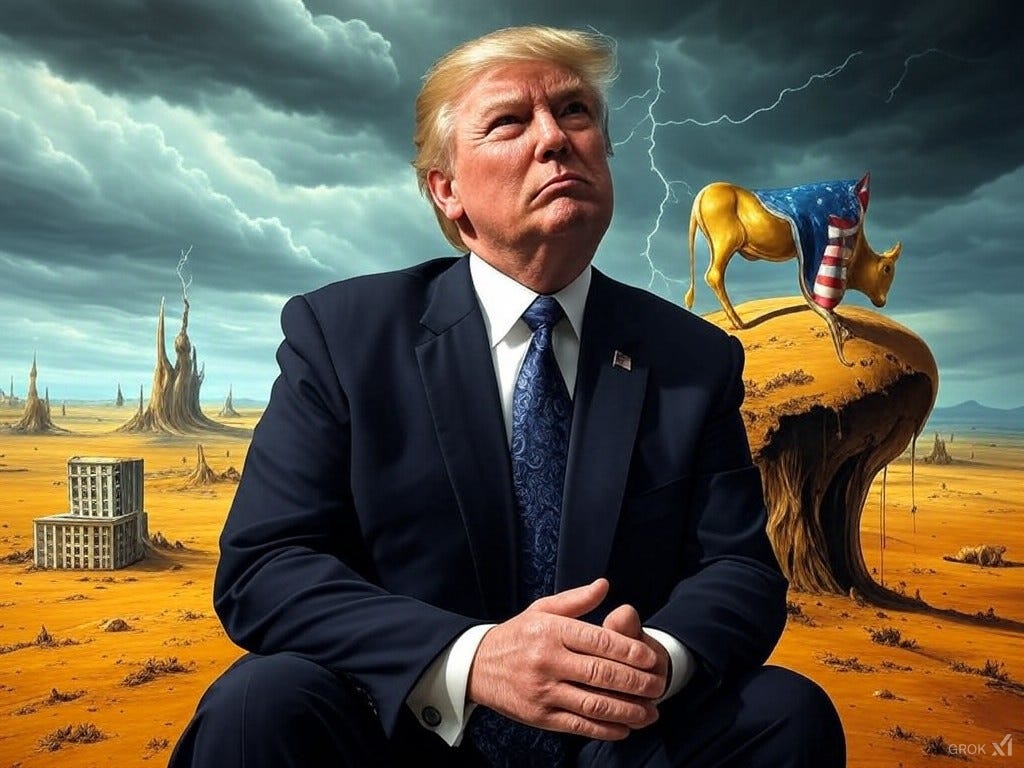
We've entered a new era where the improbable becomes reality, and Donald J. Trump, freshly returned to the Oval Office, is steering this ship with an audacity that's nothing short of awe-inspiring.
His first month has been a whirlwind of action, a testament to a man who doesn't just talk about change, but implements it with the ferocity of a lion reclaiming its throne.
He turned the Super Bowl into his stage, standing shoulder to shoulder with cops as a calculated move in the chess game of public perception. It was a spectacle, a moment where Trump wasn't just president; he was the ringmaster, pulling at the strings of American sentiment with a grin.
So here we are; it’s been roughly a month since Donald Trump took the oath of office and initiated what Steve Bannon has been calling “the days of thunder,” beginning the process of dismantling both the deep and administrative states, so, I think it’s time for a progress report, one that reaches outside of our echo chamber and includes criticisms coming from our weird cousins in the anti-establishment, anti-Trump crowd.
I guarantee that you will not agree with some of the views included in this post—I certainly don’t—but remember, it’s imperative to venture outside our safe space to understand opposing opinions.
The Good
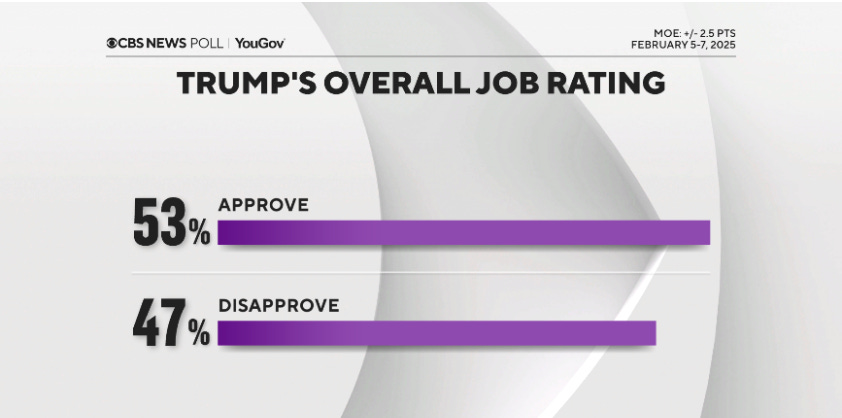
For all the meltdowns and catastrophizing from left-wing pundits and social media, Donald Trump 2.0 is enjoying a net approval rating stronger than he had at the outset of his first term.
Approval Rating
In 2020, during the initial stages of the coronavirus pandemic, Trump saw his approval rating reach 49% in some polls. This was seen as the high point of his first term.
On February 9th, CBS News published polls showing Trumps popularity at an all time high.
Even CNN has had to acknowledge the glaring truth of it.
As of February 9th, his net approval is up nearly 10 points from where it was this time in 2017, including the CBS, IPSOS, Pew, and Gallup polls. Additionally, as of the 9th, Trump’s approval has been in the green for 20 days straight, whereas, in his first term, he was only in the positive 11 days total.
Now, you can make arguments about the accuracy and integrity of the polls then and now, but regardless, optics are optics, and despite all of the drastic shake-ups driving left-wing politicians and social media to hysteria [USAID, Department of Education, etc.], this shows that the majority of the the country is actually in favor of these radical changes.
Let’s get into some of those shake-ups.
USAID
The air in D.C. is thick with the smoke of burning careers and the sound of panic. The spotlight is currently on USAID, and for the first time, Americans are starting to see the agency for what it is: a grotesque behemoth, bloated and bursting at the seams with corruption and scandal, and here we are with front-row seats, gleefully watching the autopsy.
On paper, USAID is a saint, or as Mike Benz has been putting it in interviews and lectures last week, an angel that’s lost its way.
Born in 1961 under the starry-eyed idealism of John F. Kennedy, it was supposed to be seen as America’s outstretched hand to the world—a beacon of hope, a dispenser of aid, a builder of bridges. It’s the agency that’s meant to swoop in with bags of rice, clean water, and democracy-building pamphlets, all while humming "Kumbaya" and patting itself on the back.
But if you’ve been paying attention, if you’ve got your ear to the ground, you know that USAID has always been more than just a humanitarian outfit. It’s a front, a cut-out, a velvet glove over the iron fist of U.S. foreign policy.
Beneath the veneer of humanitarian aid and global do-goodery, USAID is nothing more than a slush fund for the deep state’s pet projects, a murky cesspool where taxpayer dollars get funneled into the pockets of NGO cronies, foreign oligarchs, and regime-change architects. It’s the soft power arm of the empire, greasing the wheels for color revolutions and "democracy promotion" schemes.
You think it’s about clean water and vaccines? Think again.
It’s about buying influence, installing puppets, and keeping the global south on a short leash. Follow the money—through the labyrinth of shell companies, offshore accounts, and "consulting fees"—and you’ll find the same old cast of ghouls, the ones who never met a war they didn’t like or a country they didn’t want to destabilize.
Here’s a few of the revelations that resulted from USAID’s time in the spotlight:
The Funding of Controversial NGOs
One of the most unsurprising discoveries this month involves USAID's financial support to NGOs with contentious agendas.
Reports surfaced that USAID has been a significant funder of groups like Black Lives Matter and even organizations linked to the George Floyd riots via left-wing grant making organization the Tides Foundation.
The implications are staggering: taxpayer money, meant for international development, was instead fueling domestic political unrest. [#]
Bolstering the Censorship Network
USAID has been a significant funder of Internews—a U.S. intelligence-linked organization created to promote “press freedom” and “train journalists”— providing roughly $473 million.
Internews has been accused of supporting online censorship efforts, notably through its "Countering Disinformation Guide" and other initiatives intended to shape media narratives, both abroad and domestically.
USAID created an internal document known as the "Disinformation Primer," which explicitly promotes and endorses censorship strategies, including pushing for advertisers to financially throttle disfavored media sources and advocating for techniques like Google's Redirect Method and "prebunking" to manage public narratives.
The only thing more reprehensible than the government censoring its own citizens is using their own tax-dollars to do it.
Targeted Smears
USAID has been linked to funding groups that engage in smear campaigns and censorship against American journalists and politicians. This includes targeting individuals with anti-establishment views on both sides of the political aisle, with accusations of disinformation against people like the Grayzone’s Max Blumenthal and Vivek Ramaswamy. [#]
Gain-of-Function Research
One of the most chilling revelations might be USAID's indirect role in gain-of-function research at the Wuhan Institute of Virology.
Through EcoHealth Alliance, USAID funneled millions, contributing to research that many believe led to the COVID-19 outbreak. This isn't just a story of bad science; it's a tale of how aid money can become a weapon, even if by accident, against humanity.
So now that USAID has been splayed and cut open, people are naturally celebrating, but it’s not all sunshine and rainbows. There’s an aspect of this that is extremely dangerous, and could lead to the rapid crumbling of Western civilization if the situation isn’t handled with the utmost delicacy.
As Mike Benz put it,
“We are fundamentally restructuring the entirety of the American empire… we are conducting open heart surgery on the vital organs of the American empire itself, and I’m not fully sure that the people who are conducting that open heart surgery understand the anatomy of the organs they are operating on.”
The above video is as informative as it is alarming, and is worth the time to watch for those who care to better understand the weight of what’s happening.
The Border
Since taking office in January 2025, Donald Trump has unleashed a torrent of executive actions aimed at reshaping America's border and immigration policies, signaling a return to his hardline stance from his first term with an intensity that's both familiar and at the same time, unprecedented.
Trump's first move was to declare a national emergency at the southern border, a tactical maneuver that not only allows for the deployment of military personnel but also frames immigration in terms of national security and invasion. This rhetoric, reminiscent of his previous term, serves to justify a sweeping crackdown that includes the immediate cessation of the CBP One app, effectively shutting down a legal pathway for asylum seekers.
This action is less about immigration policy and more about exerting control and sending a message to both domestic and international audiences about who is in charge.
Trump’s targeting of the censorship industrial complex plays an important role in all of this.
By designating cartels as foreign terrorist organizations, he's not just addressing physical threats, but also informational ones. The implication here is that controlling the narrative around immigration and border security involves not just physical barriers, but also managing the flow of information, particularly in the digital realm, where narratives are spun and public opinion is molded.
The reinstatement of policies like "Remain in Mexico," plans for mass deportations, and the ending of birthright citizenship for children of undocumented immigrants have already drastically changed the threat level, though there’s still years of work to be done.
So far, things on the mass deportation front are going well, but the hardest part is yet to come. At some point, Trump’s “border tsar” Tom Homan will have to change gears; instead of focusing on the criminals, he’ll start the process of deporting regular illegals, and this is likely when democrat operatives will strike.
Television news, digital publications and social media will be bombarded with what’s been called “deportation porn”—clips and photo-ops meant to yank violently on the public’s heart strings. You’ll see images of crying children ripped from their parents, and this will likely coincide with mass rent-a-riots in major cities across the nation.
The Department of Education
The Department of Education (DOE) is on the brink of a glorious sunset.
Imagine a world where education is free from the burden of federal oversight, allowing each state to pursue its own path of learning, innovation, and cultural revitalization.
This isn't just a policy change; it's a revolution, a return to the roots of American individualism and local control.
The Trump administration's proposed closure of the DoE, with Musk's DOGE (Department of Government Efficiency) at the helm can be seen as a strategic maneuver in the ongoing war for informational sovereignty and cultural hegemony.
At its core, this isn't merely about reducing federal bureaucracy or shifting educational control to the states; it's a calculated strike against an entrenched globalist narrative that has long leveraged education as a tool for ideological dissemination.
The DOE, since its inception, has been more than just an agency; it's been a linchpin in the sprawling network of what some might call the "NGO-industrial complex," where educational policy intersects with broader geopolitical strategies. By dismantling it, Trump is not only challenging the centralized control over educational content, but is effectively attempting to disrupt the flow of what critics label as "soft power" indoctrination, particularly around issues like climate change, social justice, and global citizenship.
This move aligns with a broader pushback against international bodies and agreements perceived to infringe upon national sovereignty through cultural and educational norms.
This isn't without its risks, however.
In a Benzian analysis, such a move could also fragment the educational landscape, making it more susceptible to localized ideological battles, potentially exacerbating cultural divides rather than unifying under a common educational ethos. This could serve as a double-edged sword, where the intent to fortify national identity might instead lead to a patchwork of educational systems, each potentially at odds with the other, creating new fronts in America's ongoing culture war.
The Bad
I’d be remiss and derelict in my duty as a journalist and political commentator if I didn’t represent viewpoints that see this new administration in a less-than-favorable light.
Obviously, the big elephant in the room is Trump’s stated plans for the Gaza Strip, which more than any other issue has caused a tremendous amount of agitation and debate within the greater MAGA movement.
[Author’s note: our very own Ghost of Based Patrick Henry has had some very compelling takes on this over on his X account; I highly recommend lurking his feed and catching up on his theories.]
If the same CBS News poll mentioned earlier is to be trusted, then this is Trump’s least popular move thus far.
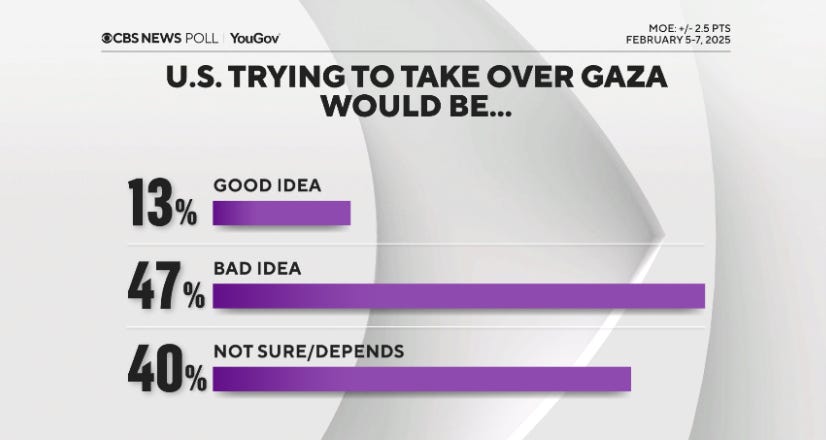
Is this yet another example of U.S. imperialism masquerading as benevolence?
The idea of "owning" Gaza and transforming it into a "Riviera of the Middle East" is something that Donald Trump had to have known would stir up a violent shitstorm.
I sincerely hope that this is merely a component of a complex plan that will culminate in peace and some semblance of justice for the innocents who have endured suffering for the past 16 months, whether through the revelation of the deceitful actions of the CIA, MOSSAD, IDF, USAID, or DEEP STATE coalitions that have orchestrated and perpetuated the circumstances in Gaza for years, ultimately fostering the conditions that precipitated October 7th, permitting it to occur, and subsequently invoking its name repeatedly to rationalize the increasingly brutal and lethal military operations that followed.
But that’s just me, as many don’t see it that way.
And then there are the criticisms and concerns coming from what I call the anti-Trump, anti-establishment faction—the Michael Traceys and Whitney Webbs of the world. We’ll call these folks ATAEF for short.
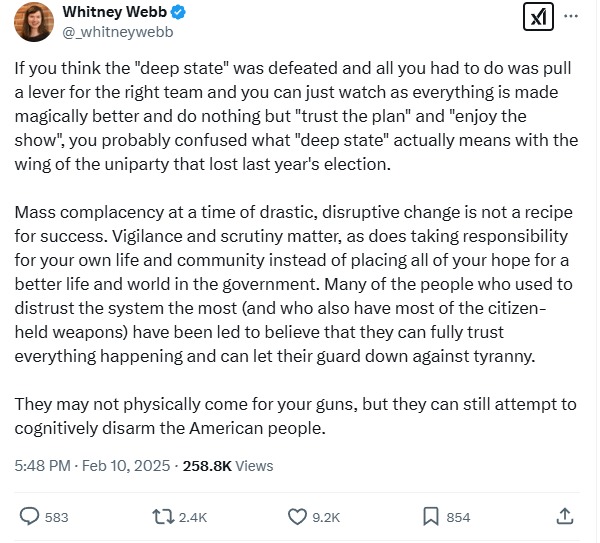
These individuals have expressed skepticism about Trump's administration due to its perceived alignment with the "deep state" or entrenched bureaucratic and corporate interests.
Despite Trump's campaign rhetoric against the establishment, commentators like Webb highlight that many of his appointments and policies seemed to reinforce rather than dismantle these structures. For instance, her discussions often point to the influence of figures like Peter Thiel [Bilderberg Steering Committee,] or the involvement of BlackRock in shaping policy, suggesting a continuity rather than a break from previous administrations.
There are increased surveillance fears, particularly regarding Thiel’s Palantir Technologies.
Palantir had a significant relationship with the U.S. government under Trump's first term. It secured contracts with agencies like Immigration and Customs Enforcement (ICE) for data analytics during immigration enforcement operations, and with the Department of Defense for military intelligence.
It appears that the Trump administration is considering or has already considered employing Palantir Technologies for various governmental functions, particularly in areas where data analytics can enhance efficiency or security; however, this doesn’t necessarily mean we should jump straight to the worst conclusions.
So, here we are, back in Trump's America, where the line between policy and performance art blurs. His first month back has been a whirlwind of action, each move a gamble in the high-stakes game of political poker. Whether this is the beginning of a revival or a descent into further madness, only time will tell. But one thing's for sure, buckle up, because this ride's just heating up.
We're all in the eye of the Trump storm, and it's going to be a hell of a trip.
As I write this, the sun is setting over D.C., and the city feels like it’s holding its breath. The old order is dying, and the new one is being born in blood and fire.
Badlands Media articles and features represent the opinions of the contributing authors and do not necessarily represent the views of Badlands Media itself.
If you enjoyed this contribution to Badlands Media, please consider checking out more of Ryan’s work for free at the Post-Liberal.
Badlands Media will always put out our content for free, but you can support us by becoming a paid subscriber to this newsletter. Help our collective of citizen journalists take back the narrative from the MSM. We are the news now.
I’m hoping to God that our soon to be new Prime Minister is taking notes and will make similar, radical changes in our broken and corrupt system. The “foreign aid” spending (aka taking $$ to laundromat) is just as bad in Canada
Good points, Ryan. I am still 100% for Trump. He may need some re-directing here & there as you have pointed out, yet change is always difficult and no one is perfect. He may make some mistakes along the way, but he is also not afraid to change his mind/policy when he’s got it wrong. The narrative takes turns, and remember he throws a head fake now and again. We have to remain calm and wait for his wind to change about some things - keep our eyes on the big prize & trust the plan.